Language Development: 2 Year Olds

Your two-year-old not only understands most of what you say to him, but also speaks with a rapidly growing vocabulary of fifty or more words. Over the course of this year, he’ll graduate from two- or three-word sentences (“Drink juice,” “Mommy want cookie”) to those with four, five, or even six words (“Where’s the ball, Daddy?” “Dolly sit in my lap”). He’s also beginning to use pronouns (I, you, me, we, they) and understands the concept of “mine” (“I want my cup,” “I see my mommy”). Pay attention to how he also is using language to describe ideas and information and to express his physical or emotional needs and desires.
It’s human nature to measure your toddler’s verbal abilities against those of other children his age, but you should try to avoid this. At this time, there’s more variation in language development than in any other area. While some preschoolers develop language skills at a steady rate, others seem to master words in an uneven manner. And some children are naturally more talkative than others. This doesn’t mean that the more verbal children are necessarily smarter or more advanced than the quieter ones, nor does it even mean that they have richer vocabularies. In fact, the quiet child may know just as many words but be choosier about speaking them. As a general rule, boys start talking later than girls, but this variation—like most others mentioned above—tends to even out as children reach school age.
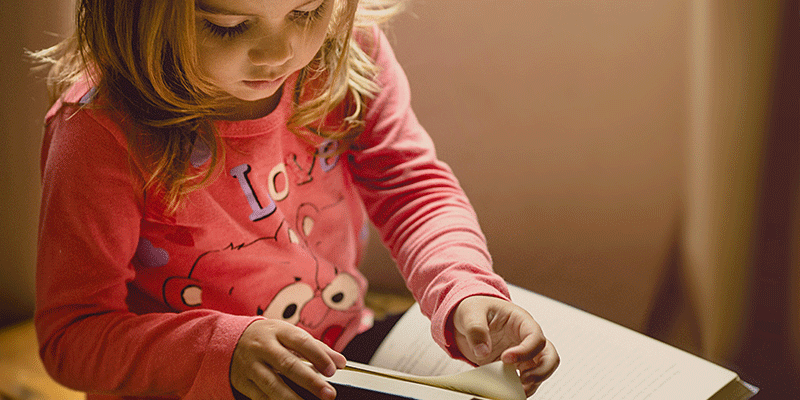
Without any formal instruction, just by listening and practicing, your child will master many of the basic rules of grammar by the time she enters school. You can help enrich his vocabulary and language skills by making reading a part of your everyday routine. At this age, he can follow a story line and will understand and remember many ideas and pieces of information presented in books. Even so, because he may have a hard time sitting still for too long, the books you read to him should be short. To keep his attention, choose activity-oriented books that encourage him to touch, point, and name objects or to repeat certain phrases. Toward the end of this year, as his language skills become more advanced, he’ll also have fun with poems, puns, or jokes that play with language by repeating funny sounds or using nonsense phrases.
For some children, however, this language-development process does not run smoothly. In fact, about one in every ten to fifteen children has trouble with language comprehension and/or speech. For some children, the problem is caused by hearing difficulty, low intelligence, lack of verbal stimulation at home, or a family history of speech delays. In most cases, though, the cause is unknown. If your pediatrician suspects your child has difficulty with language, he’ll conduct a thorough physical exam and hearing test and, if necessary, refer you to a speech/language or early-childhood specialist for further evaluation. Early detection and identification of language delay or hearing impairment is critically important, so treatment can begin before the problem interferes with learning in other areas. Unless you and your pediatrician identify the difficulty and do something about it, your child may have continuous trouble with classroom learning.
Last Updated 8/1/2009
Source Caring for Your Baby and Young Child: Birth to Age 5 (Copyright © 2009 American Academy of Pediatrics)
The information contained on this Web site should not be used as a substitute for the medical care and advice of your pediatrician. There may be variations in treatment that your pediatrician may recommend based on individual facts and circumstances.
Language Development: 1 Year Olds

Early in the second year, your toddler will suddenly seem to understand everything you say. You’ll announce lunchtime and he’ll be waiting by his high chair. You’ll tell him you’ve lost your shoe and he’ll find it. At first, his rapid response may seem a little unusual. Did he really understand, or is this just a dream? Rest assured, it’s not your imagination. He’s developing his language and comprehension skills right on schedule.
This giant developmental leap probably will alter the way you now talk to him and converse with others when he’s around. For example, you may edit conversations held within his earshot, perhaps spelling out words you’d rather he didn’t understand (as in, “Should we stop for I-C-E C-R-E-A-M?”). At the same time, you’ll probably feel more enthusiastic about talking to him, because he’s so responsive.
You may find yourself using less baby talk, no longer needing high-pitched singsong monologues to get his attention. Instead, try speaking slowly and clearly, using simple words and short sentences. Teach him the correct names of objects and body parts, and stop using cute substitutes such as “piggies” when you really mean “toes.” By providing a good language model, you’ll help him learn to talk with a minimum of confusion.
Most toddlers master at least fifty spoken words by the end of the second year and can put two words together to form a short sentence, although there are differences among children. Even among those with normal hearing and intelligence, some don’t talk much during the second year. Boys generally develop language skills more slowly than girls. Whenever your child begins to speak, his first few words probably will include the names of familiar people, his favorite possessions, and parts of his body. You may be the only person who understands these early words, since he’ll omit or change certain sounds. For example, he might get the first consonant (b, d, t) and vowel (a, e, i, o, u) sounds right, but drop the end of the word. Or he may substitute sounds he can pronounce, such as d or b, for more difficult ones.
You’ll learn to understand what he’s saying over time and with the help of his gestures. By all means, don’t ridicule his language mistakes. Give him as much time as he needs to finish what he wants to say without hurrying, and then answer with a correct pronunciation of the word (“That’s right, it’s a ball!”). If you’re patient and responsive, his pronunciation will improve gradually.
By midyear, he’ll use a few active verbs, such as “go” and “jump,” and words of direction, such as “up,” “down,” “in,” and “out.” By his second birthday, he’ll have mastered the words “me” and “you” and use them all the time.
At first, he’ll make his own version of a whole sentence by combining a single word with a gesture or grunt. He might point and say “ball”—his way of telling you he wants you to roll him the ball. Or he might shape a question by saying “Out?” or “Up?”—raising his voice at the end. Soon he’ll begin to combine verbs or prepositions with nouns, to make statements like “Ball up” or “Drink milk,” and questions like “What that?” By the end of the year, or soon thereafter, he’ll begin to use two-word sentences.
Last Updated 8/1/2009
Source Caring for Your Baby and Young Child: Birth to Age 5 (Copyright © 2009 American Academy of Pediatrics)
The information contained on this Web site should not be used as a substitute for the medical care and advice of your pediatrician. There may be variations in treatment that your pediatrician may recommend based on individual facts and circumstances.
Sleep Challenges: Why It Happens, What to Do?

By Claire Lerner and Rebecca Parlakian
Learn how to make sense of your infant or toddler’s sleep problems, and find out how to appropriately address them.
Few parents get through the early years without struggling with some kind of sleep issue with their child. Consider some of the examples below. Do any of these sound familiar to you?
- Eight-week-old Tabitha falls asleep quickly as her mom rocks and sings to her. But the second her mom puts her down, Tabitha starts to cry until her mother picks her up again.
- Brian, 16 months, still wakes up 2~3 times a night and can’t go back to sleep unless his mom or dad pats his back for up to 30 minutes.
- Natasha, 33 months, refuses to go to sleep without a bedtime routine that seems to get longer each night. Even after “lights out,” she calls for her dad or grandmother many times for drinks of water and trips to the bathroom.
While there are no easy answers or one-size-fits-all approaches to solving sleep challenges, there is a lot you can do to help your child become a good sleeper. Trying the strategies below, modifying them to meet the needs of your child and family, is a first step. With sensitivity, patience, and consistency, hopefully you will all be sleeping better soon.
Think about:
Think about the following questions to help you adapt and apply the information and strategies below to meet the needs of your individual child and family:
- What do you find most challenging about your child’s sleep habits? Why?
- What do you think are the reason(s) for your child’s sleep challenge?
- What have you tried that has worked? Not worked? What can you learn from this?
Hand and Finger Skills: 2 Year Olds

At age two, your child will be able to manipulate small objects with ease. He’ll turn the pages of a book, build a tower six blocks high, pull off his shoes, and unzip a large zipper. He’ll also coordinate the movements of his wrist, fingers, and palm so well that he can turn a doorknob, unscrew a jar lid, use a cup with one hand, and unwrap paper from a candy.
One of his major accomplishments this year will be learning to “draw.” Hand him a crayon and watch what happens: He’ll place his thumb on one side of it and his fingers on the other, then awkwardly try to extend his index or middle finger toward the point. Clumsy as this grip may seem, it will give him enough control to create his first artistic masterpieces, using sweeping vertical and circular strokes.
Fortunately, your child’s quiet play at this age will be much more focused than it was at eighteen months, when he was into everything. His attention span is longer, and now that he can turn pages, he’ll be an active participant as you look at books or magazines together. He’ll also be interested in activities such as drawing, building, or manipulating objects, so blocks and interlocking construction sets may keep him entertained for long periods. And if you let him loose with a box of crayons or a set of finger-paints, his creative impulses will flourish.
Last Updated 8/1/2009
Source Caring for Your Baby and Young Child: Birth to Age 5 (Copyright © 2009 American Academy of Pediatrics)
The information contained on this Web site should not be used as a substitute for the medical care and advice of your pediatrician. There may be variations in treatment that your pediatrician may recommend based on individual facts and circumstances.
Hand and Finger Skills: 1 Year Olds

Given all the large motor skills your one-year-old is mastering, it’s easy to overlook the more subtle changes in her ability to use her hands, both alone and in coordination with her eyes. These developments will allow her much more control and precision as she examines objects and tries new movements. They also will greatly expand her ability to explore and learn about the world around her.
At twelve months, it’s still a challenge for her to pick up very small objects between her thumb and forefinger, but by the middle of her second year, this task will be simple. Watch how she’ll manipulate small objects at will, exploring all the ways they can be combined and changed. Some of her favorite games might include:
Building towers of up to four blocks, then knocking them down
Covering and uncovering boxes or other containers
Picking up balls or other objects in motion
Turning knobs and pages
Putting round pegs into holes
Scribbling and painting
These activities not only will help her develop hand skills but also will teach her spatial concepts, such as “in,” “on,” “under,” and “around.” As she nears two years and her physical coordination improves, she’ll be able to try more complex games, such as:
Folding paper (if you show her how)
Putting large square pegs into matching holes (which is more difficult than it is with round pegs, because it involves matching angles)
Stacking up to five or six blocks
Taking toys apart and putting them back together
Making shapes from clay
By her second birthday, your toddler may demonstrate a clear tendency toward right- or left-handedness. However, many children don’t show this preference for several years. Other children are ambidextrous, being able to use both hands equally well. They may never establish a clear preference. There’s no reason to pressure your toddler to use one hand over the other or to rush the natural process that leads her to this preference.
Last Updated 8/1/2009
Source Caring for Your Baby and Young Child: Birth to Age 5 (Copyright © 2009 American Academy of Pediatrics)
The information contained on this Web site should not be used as a substitute for the medical care and advice of your pediatrician. There may be variations in treatment that your pediatrician may recommend based on individual facts and circumstances.
How to Start Good Sleeping Habits Early(Part2)

By Claire Lerner and Rebecca Parlakian
Put baby to sleep when he is awake.
Beginning at around 4 months of age, you can help your baby learn to fall asleep on his own by putting him to sleep when he is drowsy but not asleep. Learning to fall asleep on his own also helps him get himself back to sleep when he awakens in the middle of the night. When you rock your baby to sleep, rub his back, or feed him until he falls asleep, he may have trouble putting himself back to sleep when he wakens at night. He needs you to get him back to sleep. There’s no right or wrong way to put your baby to sleep. Your bedtime approach depends on your beliefs, values, and goals around sleep.
Plan for protests.
As your child learns to fall asleep on her own, she may cry or protest. This is very common,as it is a big change for her. So it’s important to have a plan for how to respond when she cries out for you, which naturally can be very distressing. For example, you might want to peek your head in every few minutes to assure her you are still there. Or you may decide not to go in at all after you put her down (unless, of course, you think something is wrong). Some parents choose this latter approach because going in and out can excite the baby and even upset her more. Think through these options, talk about them with your partner, and decide together how you want to respond. This can help you feel more prepared and better able to follow through on your plan.
Love the “lovey.”
For children over age 1,a lovey (e.g.a treasured stuffed animal or soft blanket) can be an important part of a child’s bedtime routine. Some parents choose to give their child a lovey that the child uses to comfort and soothe himself to sleep. The lovey can ease the separation that some children feel when their parents leave the room at night.
Turn off the TV.
Watching television together doesn’t often work well as a bedtime routine. The goal of the bedtime routine is to help children relax and get ready for bed. TV shows are often noisy and stimulating, which makes it difficult for children to wind down. Also, even though children are sitting near their parents while they watch television, it’s not the same as having one-on-one attention during a bedtime story.
How to Start Good Sleeping Habits Early(Part1)

By Claire Lerner and Rebecca Parlakian
Read below about ways to help your child learn to fall asleep (and fall back to sleep) beginning from the earliest months of life.
Keep it routine.
Learning how to predict what will happen next is very important for young children as it helps them feel secure and in control of their world. Bedtime routines help babies learn when it’s time to go to sleep. Having a bedtime routine means doing the same thing as much as possible every time you put your baby to sleep. Families will have different routines based on their culture and the needs of their individual child. What’s most important is that the routine stays basically the same from day to day, and that it is comforting, loving, and relaxing for your child.
Read the signs.
Watch for the ways your baby lets you know he is tired. Yawning is the most obvious hint, but there are others, too. Your baby may have a certain sleepy cry, or he may pull on his ear, rub his eyes, or be fussy. When you see these signs, slow things down and start your bedtime routine.
Consider what’s going on in your child’s life.
There are situations and events that can lead to or worsen sleep problems (e.g.separation from a parent, a new sibling, or a new caregiver). Even exciting milestones, such as learning a new skill (e.g.walking), can temporarily disrupt your child’s sleep. When this happens, be patient and consistent, and try to maintain your bedtime routine. With time and patience, your child’s sleep will likely get back on track.
Take into account your child’s temperament.
Different babies develop self-soothing skills at different rates and in different ways. The more reactive or intense your baby is, the more challenging it may be for her to soothe herself. These babies often need more help to be calmed. Babies who are less reactive tend to be able to handle minor stresses, such as a sudden loud noise, and therefore find it easier to fall asleep on their own.
Be consistent.
Time and patience are needed when teaching your child any new skill. Consistency helps children learn what to expect. If you change your response from night to night, it is confusing and makes it more difficult for your baby to adapt. When you are consistent in what you do at bedtime and nap-time, you help your baby learn new bedtime skills more quickly and easily.
Cognitive Development: 8 to 12 Months

An eight-month-old is curious about everything, but he also has a very short attention span and will move rapidly from one activity to the next. Two to three minutes is the most he’ll spend with a single toy, and then he’ll turn to something new. By twelve months, he may be willing to sit for as long as fifteen minutes with a particularly interesting plaything, but most of the time he’ll still be a body in motion, and you shouldn’t expect him to be any different.
Ironically, although toy stores are brimming with one expensive plaything after another, the toys that fascinate children most at this age are ordinary household objects such as wooden spoons, egg cartons, and plastic containers of all shapes and sizes. Your baby will be especially interested in things that differ just a bit from what he already knows, so if he’s bored with the oatmeal box he’s been playing with, you can renew his interest by putting a ball inside or turning it into a pull toy by tying a short string to it. These small changes will help him learn to detect small differences between the familiar and the unfamiliar. Also, when you choose playthings, remember that objects too much like what he’s seen before will be given a quick once-over and dismissed, while things that are too foreign may be confusing or frightening. Look instead for objects and toys that gradually help him expand his horizons.
Often your baby won’t need your help to discover objects that fall into this middle ground of newness. In fact, as soon as he can crawl, he’ll be off in search of new things to conquer. He’ll rummage through your drawers, empty out wastebaskets, ransack kitchen cabinets, and conduct elaborate experiments on everything he finds. (Make sure there’s nothing that can hurt him in those containers, and keep an eye on him whenever he’s into these things.) He’ll never tire of dropping, rolling, throwing, submerging, or waving objects to find out how they behave. This may look like random play to you, but it’s your child’s way of finding out how the world works. Like any good scientist, he’s observing the properties of objects, and from his observations, he’ll develop ideas about shapes (some things roll and others don’t), textures (things can be scratchy, soft, or smooth), and sizes (some things fit inside each other). He’ll even begin to understand that some things are edible and others aren’t, although he’ll still put everything into his mouth just to be sure. (Again, make sure there’s nothing dangerous lying around that he can put in his mouth.)
His continuing observations during these months also will help him understand that objects exist even when they’re out of his sight. This concept is called object permanence. At eight months, when you hide a toy under a scarf, he’ll pick up the scarf and search for the toy underneath—a response that wouldn’t have occurred three months earlier. Try hiding the toy under the scarf and then removing it when he’s not looking, however, and your eight-month-old will be puzzled. By ten months, he’ll be so certain that the toy still exists that he’ll continue looking for it. To help your baby learn object permanence, play peekaboo with him. By switching from one variation of this game to another, you’ll maintain his interest almost indefinitely.
As he approaches his first birthday, your child will become increasingly conscious that things not only have names but that they also have particular functions. You’ll see this new awareness weave itself into his play as a very early form of fantasy. For example, instead of treating a toy telephone as an interesting object to be chewed, poked, and banged, he’ll put the receiver to his ear just as he’s seen you do. You can encourage important developmental activities like this by offering him suggestive props—a hairbrush, toothbrush, cup, or spoon—and by being an enthusiastic audience for his performances.
Last Updated 8/1/2009
Source Caring for Your Baby and Young Child: Birth to Age 5 (Copyright © 2009 American Academy of Pediatrics)
The information contained on this Web site should not be used as a substitute for the medical care and advice of your pediatrician. There may be variations in treatment that your pediatrician may recommend based on individual facts and circumstances.
Cognitive Development: 4 to 7 Months

During your baby’s first four months, did you have doubts that she really understood much that was happening around her? This parental reaction is not surprising. After all, although you knew when she was comfortable and uncomfortable, she probably showed few signs of actually thinking. But studies show that from the minute your baby is born, she is learning about the world around her, even though it may not be apparent to you or others. Now, as her memory and attention span increase, you’ll start to see evidence that she’s not only absorbing information but also applying it to her day-to-day activities.
During this period, one of the most important concepts she’ll refine is the principle of cause and effect. She’ll probably stumble on this notion by accident somewhere between four and five months. Perhaps while kicking her mattress, she’ll notice the crib shaking. Or maybe she’ll realize that her rattle makes a noise when she hits or waves it. Once she understands that she can cause these interesting reactions, she’ll continue to experiment with other ways to make things happen.
Your baby will quickly discover that some things, such as bells and keys, make interesting sounds when moved or shaken. When she bangs certain things on the table or drops them on the floor, she’ll start a chain of responses from her audience, including funny faces, groans, and other reactions that may lead to the reappearance—or disappearance—of the object. Before long, she’ll begin dropping things intentionally to see you pick them up. As annoying as this may be at times, it’s one important way for her to learn about cause and effect and her personal ability to influence her environment.
It’s important that you give your child the objects she needs for these experiments and encourage her to test her “theories.” But make sure that everything you give her to play with is unbreakable, lightweight, and large enough that she can’t possibly swallow it. If you run out of the usual toys or she loses interest in them, plastic or wooden spoons, unbreakable cups, and jar or bowl lids and boxes are endlessly entertaining and inexpensive.
Another major discovery that your baby will make toward the end of this period is that objects continue to exist when they’re out of her sight—a principle called object permanence. During her first few months, she assumed that the world consisted only of things that she could see. When you left her room, she assumed you vanished; when you returned, you were a whole new person to her. In much the same way, when you hid a toy under a cloth or a box, she thought it was gone for good and wouldn’t bother looking for it. But sometime after four months, she’ll begin to realize that the world is more permanent than she thought. You’re the same person who greets her every morning. Her teddy bear on the floor is the same one that was in bed with her the night before. The block that you hid under the can did not actually vanish after all. By playing hiding games like peekaboo and observing the comings and goings of people and things around her, your baby will continue to learn about object permanence for many months to come.
Last Updated 8/1/2009
Source Caring for Your Baby and Young Child: Birth to Age 5 (Copyright © 2009 American Academy of Pediatrics)
The information contained on this Web site should not be used as a substitute for the medical care and advice of your pediatrician. There may be variations in treatment that your pediatrician may recommend based on individual facts and circumstances.
Cognitive Development: Two-Year-Old

Think back to your child’s infancy and early toddler months. That was a time when he learned about the world by touching, looking, manipulating, and listening. Now, as a two-year-old, the learning process has become more thoughtful. His grasp of language is increasing, and he’s beginning to form mental images for things, actions, and concepts. He also can solve some problems in his head, performing mental trial-and-error instead of having to manipulate objects physically. And as his memory and intellectual abilities develop, he’ll begin to understand simple time concepts, such as “You can play after you finish eating.”
Your toddler also is starting to understand the relationship between objects. For instance, he’ll be able to match similar shapes when you give him shape sorting toys and simple jigsaw puzzles. He’ll also begin to recognize the purpose of numbers in counting objects—especially the number two. And as his understanding of cause and effect develops, he’ll become much more interested in winding up toys and turning lights and appliances on and off.
You’ll also notice your toddler’s play growing more complex. Most noticeably, he’ll start stringing together different activities to create a logical sequence. Instead of drifting randomly from one toy to another, he may first put a doll to bed and then cover it up. Or he may pretend to feed several dolls, one after the other. Over the next few years, he’ll put together longer and more elaborate sequences of make-believe, acting out much of his own daily routine, from getting up in the morning to taking a bath and going to bed at night.
If we were to single out the major intellectual limitation at this age, it would be your child’s feeling that everything that happens in his world is the result of something he has done. With a belief like this, it becomes very difficult for him to understand correctly such concepts as death, divorce, or illness, without feeling that he played some role in it. So if parents separate or a family member gets sick, children often feel responsible.
Reasoning with your two-year-old is often difficult. After all, he views everything in extremely simple terms. He still often confuses fantasy with reality unless he’s actively playing make-believe. Therefore, during this stage, be sure to choose your own words carefully: Comments that you think are funny or playful—such as “If you eat more cereal, you’ll explode”—actually may panic him, since he won’t know you’re joking.
Last Updated 8/1/2009
Source Caring for Your Baby and Young Child: Birth to Age 5 (Copyright © 2009 American Academy of Pediatrics)
The information contained on this Web site should not be used as a substitute for the medical care and advice of your pediatrician. There may be variations in treatment that your pediatrician may recommend based on individual facts and circumstances.
Cognitive Development: One-Year-Old(Part2)
Before her second birthday, your toddler will excel at hiding games, remembering where hidden objects are long after they leave her sight. If you pocket her ball or cracker while she’s playing, you may forget all about it, but she won’t!
As she masters hide-and-seek, she’ll also become more understanding about separations from you. Just as she knows that a hidden object is somewhere, even when she can’t see it, she’ll now recognize that you always come back, even when you’re away from her a whole day. If you actually show her where you go when you leave her—to work or to the grocery store, for example—she’ll form a mental image of you there. This may make the separation even easier for her.
At this age, your toddler is very much the director; she lets you know what role she wants you to play in her activities. Sometimes she’ll bring you a toy so you can help her make it work; other times she’ll pull it away from you to try it by herself. Often, when she knows she’s done something special, she’ll pause and wait for your applause. By responding to these cues, you’ll provide the support and encouragement she needs to keep learning.
You also must supply the judgment that she still lacks. Yes, she now understands how certain things behave, but—because she can’t see how one thing affects another—she doesn’t yet grasp the full notion of consequences. So even though she may understand that her toy wagon will roll downhill, she can’t predict what will happen when it lands in the middle of the busy street below. Although she knows that a door swings open and shut, she doesn’t know that she has to keep her hand from getting caught in it. And even if she’s found out the hard way once, don’t assume she’s learned her lesson. Chances are she doesn’t associate her pain with the chain of events that led up to it, and she almost certainly won’t remember this sequence the next time. Until she develops her own common sense, she’ll need your vigilance to keep her safe.
Last Updated 8/1/2009
Source Caring for Your Baby and Young Child: Birth to Age 5 (Copyright © 2009 American Academy of Pediatrics)
The information contained on this Web site should not be used as a substitute for the medical care and advice of your pediatrician. There may be variations in treatment that your pediatrician may recommend based on individual facts and circumstances.
Cognitive Development: One-Year-Old(Part1)

As you watch your toddler at play, have you noticed how hard she concentrates on everything she does? Each game or task is a learning proposition, and she’ll gather all sorts of information about the way things work. She’ll also now be able to draw on facts she’s already learned in order to make decisions and find solutions to play-related challenges. However, she’ll be interested in solving only those problems that are appropriate for her developmental and learning level, so hand her a toy that fascinated her at eleven months and she may walk away bored. Or suggest a game that’s too advanced and she’ll object. She’ll be especially attracted to mechanical devices, such as wind-up toys, switches, buttons, and knobs. It may be difficult for you to judge exactly what she can and can’t handle at this age, but it’s not hard for her to decide. Provide her with a range of activities, and she’ll select the ones that are challenging but not completely beyond her abilities.
Imitation is a big part of her learning process at this age. Instead of simply manipulating household objects, as she did during her first year, she’ll actually use a brush on her hair, babble into the phone, turn the steering wheel of her toy car, and push it back and forth. At first, she’ll be the only one involved in these activities, but gradually she’ll include other players. She might brush her doll’s hair, “read” to you from her book, offer a playmate a pretend drink, or hold her toy phone to your ear. Because imitation is such an important part of her behavior and learning, now, perhaps more than ever, you need to be aware of the behaviors that you are modeling for her. Remember, things that you say or do might be replayed (either to your great pleasure or dismay!) over and over again as she plays and learns. Older siblings are crucial here. This copying behavior happens between toddlers and their older siblings. It is an ideal time to take advantage of these natural developmental cues.
Last Updated 8/1/2009
Source Caring for Your Baby and Young Child: Birth to Age 5 (Copyright © 2009 American Academy of Pediatrics)
The information contained on this Web site should not be used as a substitute for the medical care and advice of your pediatrician. There may be variations in treatment that your pediatrician may recommend based on individual facts and circumstances.


