Are Time-Outs Helpful or Harmful to Young Children?(Part1)

By Claire Lerner
What’s a parent to do when one of the most commonly used tools for discipline is called into question?
A number of recent articles in popular media that denounce the use of time-outs have sent many parents, understandably, into a tailspin. Critics believe that instead of helping children calm down, time-outs have the opposite effect—causing children to become even more distressed or out of control.
Time-outs is wrong
Further, children can become so overwhelmed by the disruption in their relationship with their parent during time-out (and by the shame they feel for being “bad”) that their emotional upset increases and their likelihood of learning from the experience decreases. But all of these negative outcomes assume that time-out is approached with anger, shaming, and harshness by the parent. When implemented this way—as punishment—time-out can no doubt be detrimental to the child.
Giving children (and parents!) space to calm themselves can be helpful, not harmful.
Opponents of time-out often suggest “time-in” which entails a parent physically comforting a child to calm him or her, no doubt a great strategy. But as anyone who has been the parent or caregiver of a young child knows, there are times when children are so out of control—throwing objects, kicking, hitting, biting—that they cannot accept comfort and in fact, the more the parent tries to soothe the child, the more out of control she gets. She’s on system overload. At these times, parents are also pushed to their emotional limit, their last nerve worked. When emotions (and cortisol levels in the brain) are sky-high, a break for both parent and child can be a healthier solution than an ongoing battle. Sure, in a perfect world, parents would be able to manage their reactions (indeed, the lion’s share of my work with parents is on helping them learn this very skill). But alas, parents are also human, and as hard as we may work on controlling our emotions, there are times when the only way that is going to happen is when we can take a break from the intensity of the moment.
In this situation, giving the child a break can actually be a positive parenting strategy. The critical factor is the way this break is implemented. When done calmly and lovingly, it can be an important opportunity to prevent further escalation, to provide both child and parent a chance to regain control, and to then come back together to solve the problem when both are calm. There are a range of ways to do this, including the ideas below that families in my practice have used with success.
Movement: 4 to 7 Months

In her first four months, your baby established the muscle control she needed to move both her eyes and her head so she could follow interesting objects. Now she’ll take on an even greater challenge: sitting up. She’ll accomplish this in small steps as her back and neck muscles gradually strengthen and she develops better balance in her trunk, head, and neck. First she’ll learn to raise her head and hold it up while lying on her stomach. You can encourage this by placing her on her stomach and extending her arms forward; then hold a rattle or other attractive toy in front of her to get her attention and coax her to hold her head up and look at you. This also is a good way to check her hearing and vision.
Once she’s able to lift her head, your baby will start pushing up on her arms and arching her back to lift her chest. This strengthens her upper body so she can remain steady and upright when sitting. At the same time she may rock on her stomach, kick her legs, and “swim” with her arms. These abilities, which usually appear at about five months, are necessary for rolling over and crawling. By the end of this period, she’ll probably be able to roll over in both directions, although babies normally vary in the age when they’re able to do so. Most children roll first from the stomach to the back and later in the opposite direction, although doing it in the opposite sequence is perfectly normal.
Once your baby is strong enough to raise her chest, you can help her practice sitting up. Hold her up or support her back with pillows or a couch corner as she learns to balance herself. Soon she’ll learn to “tripod,” leaning forward as she extends her arms to balance her upper body. Bright, interesting toys placed in front of her will give her something to focus on as she gains her balance. It will be some time before she can maneuver herself into a sitting posture without your assistance, but by six to eight months, if you position her upright, she’ll be able to remain sitting without leaning forward on her arms. Then she can discover all the wonderful things that can be done with her hands as she views the world from this new vantage point.
By the fourth month, your baby can easily bring interesting objects to her mouth. During her next four months, she’ll begin to use her fingers and thumbs together in a mitten or claw-like grip or raking motion, and she’ll manage to pick up many things. She won’t develop the pincer grasp using her index finger and thumb until she’s about nine months old, but by the sixth to eighth month, she’ll learn how to transfer objects from hand to hand, turn them from side to side, and twist them upside down.
As her physical coordination improves, your baby will discover parts of her body that she never knew existed. Lying on her back, she can now grab her feet and toes and bring them to her mouth. While being diapered, she may reach down to touch her genitals. When sitting up, she may slap her knee or thigh. Through these explorations she’ll discover many new and interesting sensations. She’ll also start to understand the function of each body part. For example, when you place her newly found feet on the floor, she may first curl her toes and stroke the carpet or wood surface, but soon she’ll discover she can use her feet and legs to practice “walking” or just to bounce up and down. Watch out! These are all preparations for the next major milestones: crawling and standing.
Last Updated 8/1/2009
Source Caring for Your Baby and Young Child: Birth to Age 5 (Copyright © 2009 American Academy of Pediatrics)
The information contained on this Web site should not be used as a substitute for the medical care and advice of your pediatrician. There may be variations in treatment that your pediatrician may recommend based on individual facts and circumstances.
Movement: 8 to 12 Months(Part3)

Although both of you will feel excited over this dramatic development, you’ll also find yourself unnerved at times, especially when she stumbles and falls. But even if you take pains to provide a safe and soft environment, it’s almost impossible to avoid bumps and bruises. Just be matter-of-fact about these accidents. Offer a quick hug or a reassuring word and send your little one on her way again. She won’t be unduly upset by these falls if you’re not.
At this stage, or even earlier, many parents start using a baby walker. Contrary to what the name suggests, these devices do not help the process of learning to walk. They actually eliminate the desire to walk. To make matters worse, they present a serious safety hazard because they can tip over easily when the child bumps into an obstacle, such as a small toy or a throw rug. Children in walkers also are more likely to fall down stairs and get into dangerous places that would otherwise be beyond their reach. For these reasons, the American Academy of Pediatrics strongly urges parents not to use baby walkers.
A stationary walker or activity center is a better choice. These do not have wheels, but seats that rotate and bounce. You may also want to consider a sturdy wagon or a “kiddie push car.” Be sure the toy has a bar she can push and that it’s weighted so it won’t tip over when she pulls herself up on it.
As your child begins to walk outside, she’ll need shoes to protect her feet. They should be comfortable and flexible with nonskid soles to avoid slips and provide room to grow; sneakers are fine. Your child does not need wedges, inserts, high backs, reinforced heels, special arches, and other features designed to shape and support the feet as they have no proven benefit for the average child. Her feet will grow rapidly during these months, and her shoes will have to keep pace. Her first pair of shoes probably will last two to three months, but you should check the fit of her shoes as often as monthly during this formative period. It’s often best to have your infant’s shoes fit by a professional trained in a child’s specific foot needs.
Many babies’ first steps are taken around their first birthday, although it’s perfectly normal for children to start walking a little earlier or later. At first, your child will walk with her feet wide apart to improve her shaky sense of balance. During those initial days and weeks, she accidentally may get going too fast and fall when she tries to stop. As she becomes more confident, she’ll learn how to stop and change directions. Before long, she’ll be able to squat to pick something up and then stand again. When she reaches this level of accomplishment, she’ll get enormous pleasure from push-pull toys—the noisier the better.
Last Updated 8/1/2009
Source Caring for Your Baby and Young Child: Birth to Age 5 (Copyright © 2009 American Academy of Pediatrics)
The information contained on this Web site should not be used as a substitute for the medical care and advice of your pediatrician. There may be variations in treatment that your pediatrician may recommend based on individual facts and circumstances.
Movement: 8 to 12 Months(Part2)

Stairs are another ready-made—but potentially dangerous—obstacle course. Although your baby needs to learn how to go up and down stairs, you should not allow her to play on them alone during this time. If you have a staircase in your home, she’ll probably head straight for it every chance she gets, so place sturdy gates at both the top and the bottom of your staircase to close off her access.
As a substitute for real stairs, let your baby practice climbing up and down steps constructed of heavy-duty foam blocks or sturdy cardboard cartons covered in fabric. At about a year of age, when your baby has become a competent crawler, teach her to go down real stairs backward. She may take a few tumbles before she understands the logic of going feet first instead of headfirst, so practice on carpeted steps and let her climb only the first few. If your home doesn’t have carpeted stairs, let her perfect this skill when you visit a home that does.
Although crawling makes a huge difference in how your baby sees the world and what she can do in it, don’t expect her to be content with that for long. She’ll see everyone else around her walking, and that’s what she’ll want to do, too. In preparation for this big step, she’ll pull herself to a standing position every chance she gets—although when she first starts, she may not know how to get down. If she cries for your help, physically show her how to bend her knees so she can lower herself to the floor without falling. Teaching her this skill will save you many extra trips to her room at night when she’s standing in her crib and crying because she doesn’t know how to sit down. Once your baby feels secure standing, she’ll try some tentative steps while holding on to a support. For instance, when your hands aren’t available, she’ll “cruise” alongside furniture. Just make sure that whatever she uses for support has no sharp edges and is properly weighted or securely attached to the floor so it won’t fall on her.
As her balance improves, occasionally she may let go, only to grab for support when she feels herself totter. The first time she continues forth on her own, her steps will be shaky. At first, she may take only one step before dropping, either in surprise or relief. Soon, however, she’ll manage to keep herself up and moving until you catch her several steps later. As miraculous as it may seem, most children advance from these first steps to quite confident walking in a matter of days.
Last Updated 8/1/2009
Source Caring for Your Baby and Young Child: Birth to Age 5 (Copyright © 2009 American Academy of Pediatrics)
The information contained on this Web site should not be used as a substitute for the medical care and advice of your pediatrician. There may be variations in treatment that your pediatrician may recommend based on individual facts and circumstances.
Movement: 8 to 12 Months(Part1)

At eight months, your baby probably will be sitting without support. Although she may topple over from time to time, she’ll usually catch herself with her arms. As the muscles in her trunk grow stronger, she’ll also start leaning over to pick up toys. Eventually she’ll figure out how to roll down onto her stomach and get back up to a sitting position.
When she’s lying on a flat surface, your baby is now in constant motion. When on her stomach, she’ll arch her neck so she can look around, and when on her back, she’ll grab her feet (or anything else nearby) and pull them to her mouth. But she won’t be content to stay on her back for long. She can turn over at will now and flip without a moment’s notice. This can be especially dangerous during diaper changes, so you may want to retire her changing table, using instead the floor or a bed from which she’s less likely to fall. Never leave her alone for an instant at any time.
All this activity strengthens muscles for crawling, a skill that usually is mastered between seven and ten months. For a while she simply may rock on her hands and knees. Since her arm muscles are better developed than her legs, she may even push herself backward instead of forward. But with time and practice she’ll discover that, by digging with her knees and pushing off, she can propel herself forward across the room toward the target of her choice.
A few children never do crawl. Instead, they use alternative movement methods, such as scooting on their bottoms or slithering on their stomachs. As long as your baby is learning to coordinate each side of her body and is using each arm and leg equally, there’s no cause for concern. The important thing is that she’s able to explore her surroundings on her own and is strengthening her body in preparation for walking. If you feel your child is not moving normally, discuss your concern with the pediatrician.
How can you encourage your child to crawl? Try presenting her with intriguing objects placed just beyond her reach. As she becomes more agile, create miniature obstacle courses using pillows, boxes, and sofa cushions for her to crawl over and between. Join in the game by hiding behind one of the obstacles and surprising her with a “peekaboo!” Don’t ever leave your baby unsupervised among these props, though. If she falls between pillows or under a box, she might not be able to pull herself out. This is bound to frighten her, and she could even smother.
Last Updated 8/1/2009
Source Caring for Your Baby and Young Child: Birth to Age 5 (Copyright © 2009 American Academy of Pediatrics)
The information contained on this Web site should not be used as a substitute for the medical care and advice of your pediatrician. There may be variations in treatment that your pediatrician may recommend based on individual facts and circumstances.
10 Tips to Prevent Aggressive Toddler Behavior(Part3)

When to Call the Pediatrician:
If your child seems to be unusually aggressive for longer than a few weeks, and you cannot cope with his behavior on your own, consult your pediatrician. Other warning signs include:
- Physical injury to himself or others (teeth marks, bruises, head injuries)
- Attacks on you or other adults
- Being sent home or barred from play by neighbors or school
- Your own fear for the safety of those around him
The most important warning sign is the frequency of outbursts. Sometimes children with conduct disorders will go for several days or a week or two without incident and may even act quite charming during this time, but few can go an entire month without getting into trouble at least once.
Once several effective ways are found to reward good behavior and discourage bad, they can be used in establishing an approach that works both at home and away. The progress may be slow, but such programs usually are successful if started when the disorder is just beginning to develop.
Remember:
The best way to prevent aggressive behavior is to give your child a stable, secure home life with firm, loving discipline and full-time supervision during the toddler and preschool years.
Additional Information:
- What’s the Best Way to Discipline My Child?
- 15 Tips to Survive the Terrible 3’s
- Top Tips for Surviving Tantrums
- How to Ease Your Child’s Separation Anxiety
- How to Shape and Manage Your Young Child’s Behavior
Last Updated 12/5/2018
Source Adapted from Caring for Your Baby and Young Child: Birth to Age 5, 6th Edition (Copyright © 2015 American Academy of Pediatrics)
The information contained on this Web site should not be used as a substitute for the medical care and advice of your pediatrician. There may be variations in treatment that your pediatrician may recommend based on individual facts and circumstances.
10 Tips to Prevent Aggressive Toddler Behavior(Part2)

- Instead of fighting. Teach your child to say “no” in a firm tone of voice, to turn his back, or to find compromises instead of fighting with his body. Through example, you are teaching your child to settle differences with words—more effective and more civilized—than with physical violence.
- “Great job!”Praise your child for appropriate behavior and help explain how “grown-up” she is acting whenever she uses these tactics instead of hitting, kicking, or biting. And always reinforce and praise behavior when you catch your child being kind and gentle.
- Time-outs are OK. There’s also nothing wrong with using a time-out when your child’s behavior is inappropriate, and they can be used in children as young as one year old. See How to Give a Time-Out for more information.
- Control your own temper.Always watch your own behavior around your child. One of the best ways to teach him appropriate behavior is to control your own temper. If you express your anger in quiet, peaceful ways, your child probably will follow your example.
- Stay strong.If you must discipline your child, do not feel guilty about it and certainly don’t apologize. If your child senses your mixed feelings, he will convince himself that he was in the right all along and you are the “bad” one. Although disciplining your child is never pleasant, it is a necessary part of parenthood, and there is no reason to feel guilty about it. Your child needs to understand when he is in the wrong, it is important to take responsibility for his actions and be willing to accept the consequences.
What’s the difference between discipline and punishment?
While many parents think that discipline and punishment are the same thing, they are not.
- Discipline is a way of teaching and a way of enhancing a good parent-child relationship. When you discipline, you should provide your child with praise along with instruction in a firm tone, with the intent of improving his or her behavior.
- Punishment is a negative, in which you’re dispensing an unpleasant consequence when your child does or doesn’t do something. Punishment is a part of discipline, but only a small part.
Until age three and sometimes later, children simply don’t understand the concept of punishment. Setting limits is a much better approach than punishment; most children will respond to clear, calm, and decisive limit-setting.
Last Updated 12/5/2018
Source Adapted from Caring for Your Baby and Young Child: Birth to Age 5, 6th Edition (Copyright © 2015 American Academy of Pediatrics)
The information contained on this Web site should not be used as a substitute for the medical care and advice of your pediatrician. There may be variations in treatment that your pediatrician may recommend based on individual facts and circumstances.
10 Tips to Prevent Aggressive Toddler Behavior(Part1)

There are many times when your child’s behavior warms and embraces your heart. But, there are other times when it probably drives you a little crazy. As a toddler or preschooler, your child may lack the self-control to express anger peacefully and may naturally lash out, perhaps hitting or biting in frustration.
While occasional outbursts are normal―especially during temper tantrums―there are things you can do to shape your child’s behavior.
- Teach the house rules.Children don’t know the rules of the house until they’re taught them, so that is one of your important parenting responsibilities. Toddlers are normally interested in touching and exploring, so if there are valuables you don’t want them to handle, hide or remove them. Consider setting up a separate portion of your home where your child can play with books and toys. Whenever children break an important rule, they should be reprimanded immediately to understand exactly what they have done wrong.
- Threats are over-rated. It is always more effective to positively reinforce desired behaviors and to teach children alternative behaviors rather than just say, “Stop it or else.” Tell them that the next time they are angry, they should use their words instead.
- Enter healthy distractions.While teaching your child other ways to respond, there’s also nothing wrong with distracting him at times or trying another approach. As long as you’re not “bribing” him to behave differently by offering sweet snacks. For example, there’s nothing wrong with intentionally changing his focus.
- “Control yourself.”Well, they can’t yet. Remember, toddlers have little natural self-control. They need you to teach them not to kick, hit, or bite when they are angry, but instead to express their feelings through words.
- “We don’t hurt each other.” Supervise your child carefully when she is involved in disputes with playmates. If a disagreement is minor, keep your distance and let the children solve it on their own. However, you must intervene when children get into a physical fight that continues even after they’re told to stop, or when one child seems to be in an uncontrollable rage and is assaulting or biting the other. Pull the children apart and keep them separate until they have calmed down. If the fight is extremely violent, you may have to end the play session. Make it clear that it doesn’t matter who “started it.” There is no excuse for trying to hurt each other.
Last Updated 12/5/2018
Source Adapted from Caring for Your Baby and Young Child: Birth to Age 5, 6th Edition (Copyright © 2015 American Academy of Pediatrics)
The information contained on this Web site should not be used as a substitute for the medical care and advice of your pediatrician. There may be variations in treatment that your pediatrician may recommend based on individual facts and circumstances.
Language Development: 8 to 12 Months(Part2)

Picture books can enhance this entire process by reinforcing her budding understanding that everything has a name. Choose books with large board, cloth, or vinyl pages that she can turn herself. Also look for simple but colorful illustrations of things your child will recognize.
Whether you’re reading or talking to her, give her plenty of opportunities to join in. Ask questions and wait for a response. Or let her take the lead. If she says “Gaagaagaa,” repeat it back and see what she does. Yes, these exchanges may seem meaningless, but they tell your baby that communication is two-way and that she’s a welcome participant. Paying attention to what she says also will help you identify the words she understands and make it more likely that you’ll recognize her first spoken words.
These first words, incidentally, often aren’t proper English. For your child, a “word” is any sound that consistently refers to the same person, object, or event. So if she says “mog” every time she wants milk, you should treat “mog” with all the respect of a legitimate word. When you speak back to her, however, use “milk,” and eventually she’ll make the correction herself.
There’s a tremendous variance in the age at which children begin to say recognizable words. Some have a vocabulary of two to three words by their first birthday. More likely, your baby’s speech at twelve months will consist of a sort of gibberish that has the tones and variations of intelligible speech. As long as she’s experimenting with sounds that vary in intensity, pitch, and quality, she’s getting ready to talk. The more you respond to her as if she were speaking, the more you’ll stimulate her urge to communicate.
Last Updated 8/1/2009
Source Caring for Your Baby and Young Child: Birth to Age 5 (Copyright © 2009 American Academy of Pediatrics)
The information contained on this Web site should not be used as a substitute for the medical care and advice of your pediatrician. There may be variations in treatment that your pediatrician may recommend based on individual facts and circumstances.
Language Development: 8 to 12 Months(Part1)

Toward the end of the first year, your baby will begin to communicate what she wants by pointing, crawling, or gesturing toward her target. She’ll also imitate many of the gestures she sees adults make as they talk. This nonverbal communication is only a temporary measure, however, while she learns how to phrase her messages in words.
Do you notice the coos, gurgles, and screeches of earlier months now giving way to recognizable syllables, such as “ba,” “da,” “ga,” and “ma”? Your child may even stumble on words such as “mama” and “bye-bye” quite accidentally, and when you get excited she’ll realize she’s said something meaningful. Before long she’ll start using “mama” to summon you or attract your attention. At this age, she may also say “mama” throughout the day just to practice saying the word. Ultimately, however, she’ll use words only when she wants to communicate their meanings.
Even though you’ve been talking to your baby from birth, she now understands more language, and thus your conversations will take on new significance. Before she can say many, if any, words, she’ll probably be comprehending more than you suspect. For example, watch how she responds when you mention a favorite toy across the room. If she looks toward it, she’s telling you she understands. To help her increase her understanding, keep talking to her as much as possible. Tell her what’s happening around her, particularly as you bathe, change, and feed her. Make your language simple and specific: “I’m drying you with the big blue towel. How soft it feels!” Verbally label familiar toys and objects for her, and try to be as consistent as possible—that is, if you call the family pet a cat today, don’t call it a kitty tomorrow.
Last Updated 8/1/2009
Source Caring for Your Baby and Young Child: Birth to Age 5 (Copyright © 2009 American Academy of Pediatrics)
The information contained on this Web site should not be used as a substitute for the medical care and advice of your pediatrician. There may be variations in treatment that your pediatrician may recommend based on individual facts and circumstances.
Language Development: 4 to 7 Months(Part2)

Your participation in your child’s language development will become even more important after six or seven months, when she begins actively imitating the sounds of speech. Up to that point, she might repeat one sound for a whole day or even several days at a stretch before trying another. But now she’ll become much more responsive to the sounds she hears you make, and she’ll try to follow your lead. So introduce her to simple syllables and words such as “baby,” “cat,” “dog,” “go,” “hot,” “cold,” and “walk,” as well as “Mama” and “Dada.” Although it may be as much as a year or more before you can interpret any of her babbling, your baby can understand many of your words well before her first birthday.
If she doesn’t babble or imitate any sounds by her seventh month, it could mean a problem with her hearing or speech development. A baby with a partial hearing loss still can be startled by loud noises or will turn her head in their direction, and she may even respond to your voice. But she will have difficulty imitating speech. If your child does not babble or produce a variety of sounds, alert your pediatrician. If she has had frequent ear infections, she might have some fluid remaining in her inner ear, and this could interfere with her hearing.
Special equipment is used to check a very young baby’s hearing. All newborns should be tested for hearing loss. Your observations are the early warning system that tells whether further testing is needed. If you suspect a problem, you might ask your pediatrician for a referral to a children’s hearing specialist.
Last Updated 8/1/2009
Source Caring for Your Baby and Young Child: Birth to Age 5 (Copyright © 2009 American Academy of Pediatrics)
The information contained on this Web site should not be used as a substitute for the medical care and advice of your pediatrician. There may be variations in treatment that your pediatrician may recommend based on individual facts and circumstances.
Language Development: 4 to 7 Months(Part1)
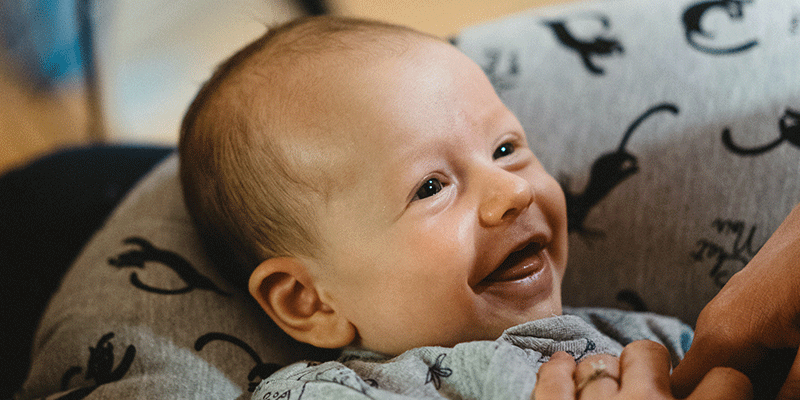
Your baby learns language in stages. From birth, she receives information about language by hearing people make sounds and watching how they communicate with one another. At first she is most interested in the pitch and level of your voice. When you talk to her in a soothing way, she’ll stop crying because she hears that you want to comfort her. By contrast, if you shout out in anger, she probably will cry, because your voice is telling her something is wrong. By four months, she’ll begin noticing not only the way you talk but the individual sounds you make. She’ll listen to the vowels and consonants and begin to notice the way these combine into syllables, words, and sentences.
Besides receiving sounds, your baby also has been producing them from the very beginning, first in the form of cries and then as coos. At about four months, she’ll start to babble, using many of the rhythms and characteristics of her native language. Although it may sound like gibberish, if you listen closely, you’ll hear her raise and drop her voice as if she were making a statement or asking a question. Encourage her by talking to her throughout the day. When she says a recognizable syllable, repeat it back to her and then say some simple words that contain that sound. For example, if her sound of the day is “bah,” introduce her to “bottle,” “box,” “bonnet,” and “Baa, Baa, Black Sheep.”
Last Updated 8/1/2009
Source Caring for Your Baby and Young Child: Birth to Age 5 (Copyright © 2009 American Academy of Pediatrics)
The information contained on this Web site should not be used as a substitute for the medical care and advice of your pediatrician. There may be variations in treatment that your pediatrician may recommend based on individual facts and circumstances.


