Alcohol & Breast Milk(Part2)
Alcohol & Breast Milk(Part2)
Mercury. Most people are not affected by these tiny amounts of mercury, but mercury can cause damage to the nervous system in babies and small children. The American College of Obstetricians and Gynecologists (ACOG) encourages breastfeeding mothers to follow the FDA and U.S. Environmental Protection Agency (EPA) advice regarding fish consumption:
- Eat 2-3 servingsa week (8 to 12 ounces in total) of a variety of fish
- Eat only 1 servinga week (no more than 6 ounces) of some fish, such as albacore (white) tuna and fish with similar mercury concentrations to albacore (white) tuna
- Avoid certain fishwith the highest mercury concentrations
- Check for advisoriesfor fish caught by family and friends and where no advisories exist; limit eating those fish to one serving a week and do not eat other fish that week.
Marijuana. No amount of marijuanahas been proven safe to use during pregnancy or while breastfeeding. You may pass the chemicals from marijuana to your baby through breastmilk. A study in the September 2018 Pediatrics confirms earlier findings that THC can transfer into breastmilk. The AAP also reminds that a mother’s ability to care for an infant may be impaired while using marijuana. Bottomline: If you are breastfeeding, don’t use marijuana.
Tobacco, including e-cigarettes. Inhaled nicotine enters a mother’s blood through her lungs, and then easily passes into breastmilk. Research shows that nicotine in a mother’s breastmilk can affect infant sleep pattern. Nicotine is also thought to decrease milk supply in nursing mothers, possibly by lowering levels of the breastmilk-stimulating hormone prolactin.
Note: Because of the many benefits breastfeeding has for infants and moms, the AAP and the ACOG recommend breastfeeding even if you continue to use e-cigarettes. If it’s not the right time for you to quit, make a plan to reduce your baby’s exposure to cigarette smoke. Learn more here.
Last Updated 7/17/2020
Source American Academy of Pediatrics (Copyright © 2019)
The information contained on this Web site should not be used as a substitute for the medical care and advice of your pediatrician. There may be variations in treatment that your pediatrician may recommend based on individual facts and circumstances.
Alcohol & Breast Milk(Part1)
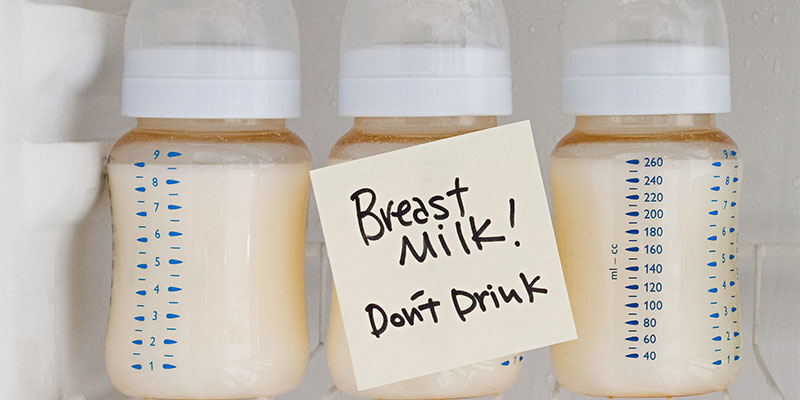
Alcohol passes through your breast milk to your baby, so the American Academy of Pediatrics (AAP) recommends avoiding drinking alcohol while breastfeeding.
What You Should Know:
- Drinking beer does not increase your milk supply, as urban myth(s) suggests.
- Consuming alcohol of any kind may decrease the amount of milk your baby drinks.
- Alcohol can change the taste of your milk, and some babies may not like it.
- Breastfeeding your baby while consuming alcohol can pose a risk to your infant if he or she consumes breast milk with alcohol.
- Expressing or pumping milk after drinking alcohol, and then discarding it (“pumping and dumping”), does NOT reduce the amount of alcohol present in your milk quicker. As your alcohol blood level falls over time, the level of alcohol in your breast milk will also decrease. Breast milk continues to contain alcohol if alcohol is still in your bloodstream.
If You Choose to Have an Alcoholic Drink:
alcoholic-drink-graphic.If you are going to have an alcohol containing beverage, it is best to do so just after you nurse or pump milk rather than before.
Breastfeeding or pumping breast milk is ok 2 hours after your last drink. That way, your body will have as much time as possible to rid itself of the alcohol before the next feeding and less will reach your infant.
Caring for a baby while intoxicated is not safe!
Drinking alcohol could impair your judgement and your ability to safely care for your baby. If you drink excessively, arrange for a sober adult to care for your baby during this time.
Know the Effects of Repeated Alcohol Exposure to Your Breastfed Baby:
There are increasing concerns about long-term, repeated exposure of infants to alcohol via the mother’s breast milk, so moderation is advised. Chronic consumption of alcohol may also reduce milk production.
More things to avoid when breastfeeding:
Caffeine. Breast milk usually contains less than 1% of the caffeine ingested by the mom. If you drink no more than three cups of coffee spread throughout the day, there is little to no caffeine detected in the baby’s urine. However, if you feel that your infant becomes more fussy or irritable when you consume excessive amounts of caffeine―usually more than five caffeinated beverages per day―consider decreasing your intake.
Last Updated 7/17/2020
Source American Academy of Pediatrics (Copyright © 2019)
The information contained on this Web site should not be used as a substitute for the medical care and advice of your pediatrician. There may be variations in treatment that your pediatrician may recommend based on individual facts and circumstances.
Birth Control and Breastfeeding
Once you have settled into life as a breastfeeding mother, you will no doubt enjoy renewing your relationship with your partner as well. One of the welcome advantages of exclusive round-the-clock breastfeeding (no water, juice, formula, solids, or other supplements for the baby) is that it significantly reduces the chance of your becoming pregnant again during the first six months because it delays the resumption of your ovulatory cycles.
If your baby is less than six months old, your periods have not yet started again, and you are fully breastfeeding both day and night, you will probably not become pregnant even without the active use of contraceptive methods.
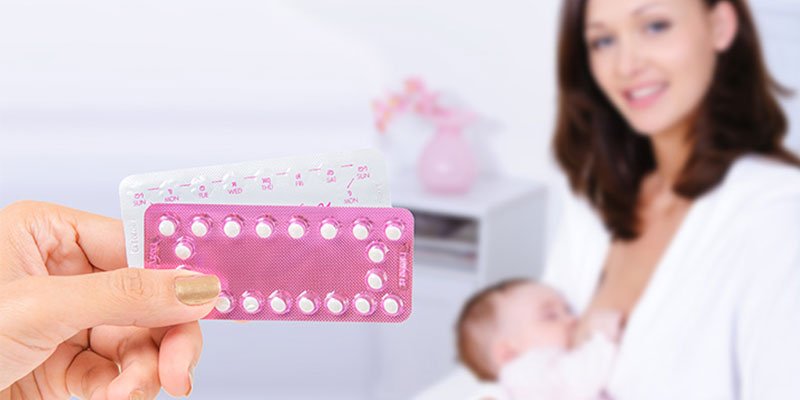
At about six weeks postpartum, once your milk supply is firmly established, you may begin using contraceptives, but be sure to discuss the issue with your infant’s pediatrician and your gynecologist first. There are no harmful effects on infants when the mother uses hormonal contraceptives, but their use may diminish milk supply, especially during the earlyweeks of breastfeeding. This is especially true when hormonal contraception is combined with stressors such as a return to work or less-frequent breastfeeding. Birth control pills with high doses of estrogen are more likely to decrease milk supply.
Condoms, a diaphragm, or a cervical cap and spermicide may be considered as alternative choices for now (even if somewhat less effective), since these forms of birth control are unlikely to interfere with your milk supply.
Last Updated 11/2/2009
Source New Mother’s Guide to Breastfeeding, 2nd Edition (Copyright © 2011 American Academy of Pediatrics)
The information contained on this Web site should not be used as a substitute for the medical care and advice of your pediatrician. There may be variations in treatment that your pediatrician may recommend based on individual facts and circumstances.
Care for an Uncircumcised Penis

Our son is not circumcised. When will his foreskin retract?
In the first several years your son’s foreskin will separate from the tip of the penis. Some foreskins separate soon after birth or even before birth, but this is rare. When it happens is different for every child. It may take a few weeks, months, or years. Once this happens, the foreskin can be pulled back away from the tip of the penis. This is called foreskin retraction.
Most boys will be able to retract their foreskins by the time they are 5 years old, yet others will not be able to until the teen years. As a boy becomes more aware of his body, he will most likely discover how to retract his own foreskin. But foreskin retraction should never be forced. Until the foreskin fully separates, do not try to pull it back. Forcing the foreskin to retract before it is ready can cause severe pain, bleeding, and tears in the skin.
Smegma
When the foreskin separates from the head of the penis, skin cells are shed. These skin cells may look like white, pearl-like lumps under the foreskin. These are called smegma. Smegma is normal and nothing to worry about.
Cleaning
If your son’s foreskin separates before he reaches puberty, an occasional retraction with cleansing beneath will do. Once your son starts puberty, he should clean beneath his foreskin as part of his daily routine, just like washing his hair and brushing his teeth.
Teach your son to clean his foreskin in the following way:
Step 1: Gently pull the foreskin back away from the end of the penis.
Step 2: Rinse underneath the foreskin with soap and warm water.
Step 3: Pull the foreskin back over the penis
Last Updated 6/19/2017
Source Care of the Uncircumcised Penis (Copyright © 2007 American Academy of Pediatrics, Updated 6/2007)
The information contained on this Web site should not be used as a substitute for the medical care and advice of your pediatrician. There may be variations in treatment that your pediatrician may recommend based on individual facts and circumstances.
Bathing Your Baby(Part4)

By: Dipesh Navsaria, MPH, MSLIS, MD, FAAP
Clean gently. Use a soft cloth to wash your baby’s face and hair, being careful not to scrub or tug the skin. Massage her entire scalp gently, including the area over her fontanelles (soft spots). When you rinse shampoo from her head, cup your hand across her forehead so the suds run toward the sides, not into her eyes. If some suds do get into her eyes, use the wet washcloth to wipe them with plain, lukewarm water. Wash the rest of her body from the top down.
Have fun in the tub. If your baby enjoys her bath, give her some extra time to splash and play in the water. The more fun your child has in the bath, the less she’ll be afraid of the water. Bathing should be a very relaxing and soothing experience, so don’t rush unless she’s unhappy.
- Young infants don’t really need bath toys, since just being in the water is usually exciting enough. Once a baby is old enough for the bathtub, however, toys become key. Containers, floating toys, even waterproof books make wonderful distractions as you cleanse your baby.
Get out and dry off. When bath time is finished, promptly wrap a towel around your baby’s head and body to help her stay warm while she is still wet. Bathing a baby of any age is wet work, so you may want to wear a terry-cloth apron or hang a towel over your shoulder to keep yourself dry. Gently pat baby dry and apply a small amount of fragrance-free, hypoallergenic moisturizing lotion right after a bath to help prevent dry skin or eczema.
Remember…
Knowing the basics can make bathing your infant a breeze. Just make sure your baby stays comfortable and safe during bath time―and don’t forget to soak up all the special moments that come with it!
Last Updated 3/3/2020
Source American Academy of Pediatrics (Copyright © 2019)
The information contained on this Web site should not be used as a substitute for the medical care and advice of your pediatrician. There may be variations in treatment that your pediatrician may recommend based on individual facts and circumstances.
Bathing Your Baby(Part3)

By: Dipesh Navsaria, MPH, MSLIS, MD, FAAP
Use touch supervision. Have a towel and other bath supplies within reach so you can keep a hand on your baby at all times. If you’ve forgotten something or need to answer the phone or door during the bath, you must take the baby with you.
- Start practicing infant water safety now:Never leave a baby alone in the bath, even for an instant. Most child drownings inside the home occur in bathtubs, and more than half of bathtub deaths involve children under 1 year of age.
Check the water temperature. Fill the basin with 2 inches of water that feels warm—not hot—to the inside of your wrist or elbow. If you’re filling the basin from the tap, turn the cold water on first (and off last) to avoid scalding yourself or your child. The American Academy of Pediatrics (AAP) recommends that the hottest temperature at the faucet should be no more than 120 degrees Fahrenheit to help avoid burns. In many cases you can adjust your water heater setting to not go above this temperature. Tap water that’s too hot can quickly cause burns serious enough to require a hospital visit or even surgery. In fact, hot water scalds are the top cause of burns among babies and young children.
Keep baby warm. Once you’ve undressed your baby, place her in the water immediately so she doesn’t get chilled. Use one of your hands to support her head and the other to guide her in, feet first. Talk to her encouragingly, and gently lower the rest of her body until she’s in the tub. Most of her body and face should be well above the water level for safety, so you’ll need to pour warm water over her body frequently to keep her warm.
Use soap sparingly. Soaps can dry out your baby’s skin. If a cleanser is needed for heavily soiled areas, use only mild, neutral-pH soaps without additives. Rinse soap from the skin right away. Wash baby’s hair two or three times a week using a mild shampoo or body wash.
- You may see some scaly patches on your baby’s scalp called cradle cap―a harmless condition that appears in many babies. You can loosen the scales with a soft-bristled brush while shampooing in the bathtub, but it’s also okay to leave it alone if it doesn’t bother you. It’s unlikely to bother your baby, and she will outgrow it.
Last Updated 3/3/2020
Source American Academy of Pediatrics (Copyright © 2019)
The information contained on this Web site should not be used as a substitute for the medical care and advice of your pediatrician. There may be variations in treatment that your pediatrician may recommend based on individual facts and circumstances.
Bathing Your Baby(Part2)

By: Dipesh Navsaria, MPH, MSLIS, MD, FAAP
Can my baby have a bath before the umbilical cord falls off?
Only give your newborn sponge baths until the stump of the umbilical cord falls off, which usually happens by about one or two weeks of age. If it remains beyond that time, there may be other issues at play. See the baby’s doctor if the cord has not dried up and fallen off by the time the baby is two months old. Learn more here.
How to give a sponge bath
A sponge bath is like a regular bath, except you don’t put your baby in the water.
Baby sponge bath safety tips:
- Get supplies ready before you begin.Have a basin of water, a damp washcloth rinsed in soap-free water, a dry towel, and anything else you might need within reach before you begin.
- Lay baby on a flat surface that is comfortable for both of you—a changing table, bed, floor, or counter next to the sink will do. Pad hard surfaces with a blanket or fluffy towel. If your baby is on a surface above the floor, always use a safety strap or keep one hand on her to prevent falls.
- Start washing the face first. Use the dampened cloth to wash her face, being careful not to get water into her eyes or mouth. Then, dip it in the basin of water before washing the rest of her body and, finally, the diaper area.
- Keep baby warm. During the sponge bath, wrap your baby in a dry towel and uncover only the parts of her body you are actively washing. Pay special attention to creases under the arms, behind the ears, around the neck, and, especially with a girl, in the genital area.
When is my baby ready for a regular bath?
Once the umbilical area is healed, you can try placing your baby directly in the water. His first baths should be as gentle and brief as possible. He may protest a little. (If this happens go back to sponge baths for a week or two, then try the bath again). Babies usually make it clear when they’re ready.
Baby bathtub safety tips:
Use an infant tub or sink. The US Consumer Product Safety Commission recommends a hard plastic baby bathtub that has a sloped, textured surface or sling that keeps your baby from sliding. Only use an infant bath tub manufactured on or after October 2, 2017 so it meets current safety standards. Some parents find it easiest to bathe a newborn in a bathinette, sink, or plastic tub lined with a clean towel. Yes, a sink! Sometimes easiest is best; just be careful. Sinks are slippery and have all sorts of things sticking out like faucets and handles.
- Avoid using bath seats. These seats provide support so a child can sit upright in an adult bathtub. Unfortunately, they can easily tip over. A child can fall into the bathwater and drown.
Last Updated 3/3/2020
Source American Academy of Pediatrics (Copyright © 2019)
The information contained on this Web site should not be used as a substitute for the medical care and advice of your pediatrician. There may be variations in treatment that your pediatrician may recommend based on individual facts and circumstances.
Bathing Your Baby(Part1)

By: Dipesh Navsaria, MPH, MSLIS, MD, FAAP
Bathing your baby is an experience many parents treasure. It’s a great time to bond, distraction-free, as your tiny new family member enjoys the sensation of warm water on their skin. Yet this common parenting ritual often comes with questions, and sometimes anxiety, about when and how to do it well.
Here are some frequently asked questions from parents about topics related to baby bath timing, frequency, safety, and more.
When should newborns get their first bath?
The timing of your baby’s very first bath has changed over the last few years. While most institutions used to bathe babies within an hour or two of birth, many are changing their policies.
The World Health Organization (WHO) recommends delaying baby’s first bath until 24 hours after birth—or waiting at least 6 hours if a full day isn’t possible for cultural reasons.
Why wait?
Here are some reasons why it is now recommended to delay baby’s first bath:
- Body temperature and blood sugar: Babies who get baths right away may be more likely to become cold and develophypothermia. The minor stress of an early bath can also make some babies more likely to have a drop in blood sugar (hypoglycemia).
- Bonding and breastfeeding:Taking the baby away for a bath too soon can interrupt skin-to-skin care, mother-child bonding, and early breastfeeding success. Onestudyshowed a 166% increase in hospital breastfeeding success after implementing a 12-hour delay in baby’s first bath compared to those bathed within the first couple hours.
- Dry skin:Vernix, a waxy white substance that coats a baby’s skin before birth, acts as a natural moisturizer and may have anti-bacterial properties. Learn more about vernix here. According to the American Academy of Pediatrics (AAP), it’s best to leave vernix on a newborns’ skin for a while to help prevent their delicate skin from drying out. This is especially important for preemies, as their skin is highly prone to injury.
Note: Babies of mothers with HIV or the Hepatitis viruses will still be bathed after the initial breastfeed in order to decrease risk to hospital staff and family members.
How often do babies need a bath once they are home?
Newborns don’t need a bath every day. They rarely sweat or get dirty enough to need a full bath that often.
Three baths per week during baby’s first year may be enough. Bathing more frequently can dry out your baby’s skin.
Last Updated 3/3/2020
Source American Academy of Pediatrics (Copyright © 2019)
The information contained on this Web site should not be used as a substitute for the medical care and advice of your pediatrician. There may be variations in treatment that your pediatrician may recommend based on individual facts and circumstances.
Heat Rash

Heat rash is seen most often in babies and young children. It occurs during hot and humid weather. It is caused when the sweat gland openings become blocked. This results in little red bumps around the sweat duct openings.
What to Look For:
- Tiny red bumps in areas that tend to be moist
- Commonly seen in skin folds of the neck and on the upper chest, arms, legs, and diaper area
What You Should Do:
Parents or primary caregiver should:
- Dress the child in clothing that keeps the skin cool and dry.
- Pay special attention to skin folds that stay wet with perspiration, urine, or drool.
- Use cool water to remove body oil and sweat. Then dry the area.
- Leave areas open to air without clothing.
- Use air conditioning or a fan blowing gently on your child to keep her cool.
- Do not apply skin ointments.
Other caregivers should:
- Tell parents if you notice a child has signs of prickly heat.
- Try to keep the child cool.
- Pay attention to moist areas. Wash with cool water. Keep these areas dry.
Last Updated 4/18/2013
Source First Aid for Families (PedFACTs) (Copyright © 2012 American Academy of Pediatrics)
The information contained on this Web site should not be used as a substitute for the medical care and advice of your pediatrician. There may be variations in treatment that your pediatrician may recommend based on individual facts and circumstances.
Nails, Nails, Everywhere!
Did you know that fingernails grow an estimated 0.1 mm each day and that they grow faster in young people, in males, and in the summertime? Well, neither did we, until we looked it up, but that is apparently the case, and it certainly doesn’t surprise us. While that may not seem like much on the surface, let us assure you that it will keep you busy. Keeping up with your newborn’s nails as they continuously grow can be a very demanding task. As far as we’re concerned, the real purpose baby nails serve is to break you into parenthood. They will likely require trimming or filing at least once a week because long nails on the hands of newborns with little to no control of them predictably result in stray scratches. If you happen to fall behind on your nail clipping, your baby will inevitably remind you (and make you feel guilty) by scratching his face when his nails get too long (or if you leave sharp corners or points when clipping).
The Baby Manicure-Pedicure
A handful of parents are intimidated by the prospect of having to cut their baby’s nails and would probably opt for a professional manicure-pedicure if only they were generally available. No such luck. If you’re lucky, your hospital nurse will be able to help demonstrate the correct technique, but some hospitals actually discourage their personnel from doing so, we can only presume because any unintentional injury may be a liability problem. And while we aren’t exactly recommending it (or admitting to doing it ourselves), we’re well aware of the fact that some parents opt to bite or peel off their newborn’s nails rather than fiddle with clippers or scissors. Because clippers and scissors can trim nails in a more controlled fashion, you’ll be better off using one or the other (or both), or simply using a nail file to keep things under control.
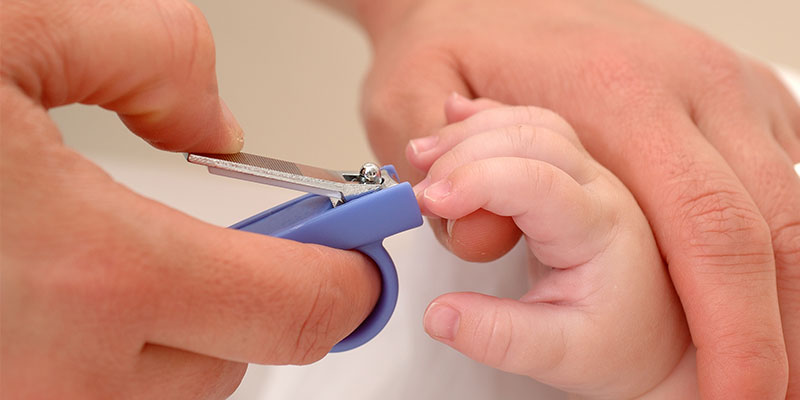
For best results, trim or file your baby’s nails when she’s asleep and her hands are less of a moving target.
Push down on the fingertip skin so you can get the clipper or scissors around both sides of the nail and avoid cutting your baby’s finger (or toe).
Then, just as a professional manicurist would, finish off any sharp or rough edges with an emery board and…
Voila! Not so bad after all once you get the hang of it.
Author Laura A. Jana, MD, FAAP and Jennifer Shu, MD, FAAP
Last Updated 11/2/2009
Source Heading Home With Your Newborn, 2nd Edition (Copyright © 2010 American Academy of Pediatrics)
The information contained on this Web site should not be used as a substitute for the medical care and advice of your pediatrician. There may be variations in treatment that your pediatrician may recommend based on individual facts and circumstances.
Breastfeeding After Your Baby Gets Teeth

Your baby’s first tooth probably will appear after six months, though some babies are born with one or more teeth and in other cases teeth don’t appear until the child is almost a year old. Many mothers decide that it’s time to stop breastfeeding when they first notice a tooth. Usually this is because the baby has nipped the breast at the end of a feeding session or because the mother fears she will be bitten. Yet many babies with teeth (or those who are teething) never bite when breastfeeding.
Did You Know: An actively nursing baby will not bite, because her tongue covers her lower teeth. A baby who nips the breast as he starts to pull away near the end of a feeding can be taught to stop. Try not to let this minor challenge get in the way of breastfeeding so early in your nursing relationship.
How to Prevent a Breastfeeding Baby from Biting
- If your baby has sprouted a tooth and you are concerned that she may nip you as a feeding ends: Keep your finger ready to break the suction and remove your breast as soon as her rhythmic suckling stops (and before she starts to drift off or feel playful).
- If she has already bitten: Say no firmly and then remove her from your breast. Try to keep this action as bland and matter-of-fact as possible. Too much anger or even amusement may interest her enough to make her want to repeat the experiment again. Once she realizes that biting means no more breast, she will learn to stifle the impulse. (Meanwhile, don’t forget to offer her a one-piece teething ring when she is not nursing.)
How to Prevent Baby-Bottle Tooth Decay
Once your baby’s teeth have begun to come in, it is important to keep in mind that even breastfeeding babies are sometimes susceptible to baby-bottle tooth decay (BBTD), a major cause of dental cavities in infants that can also cause serious damage to permanent teeth later on. BBTD results from teeth being coated in almost any liquid other than water for long periods, and occurs most commonly among babies who are put to bed with a bottle of formula or juice.
Research shows that human milk by itself does not promote tooth decay. But breastfeeding infants who fall asleep while nursing with unswallowed milk in their mouths are also vulnerable to tooth decay. Beyond the first year, dental caries—tooth decay—can occur in toddlers who receive sugary liquids in a bottle or who are nursing and eating foods with sugar and carbohydrates. Make a point of removing your breast from your baby’s mouth once she has fallen asleep.
Tips to Promote Dental Health Right from the Start
Your pediatrician will check your baby’s teeth as part of the well-child visits during the first year of life and beyond.
- To stimulate healthy gums and good oral hygiene: Wipe the gums at least once a day, beginning at birth, even before any teeth have erupted in your child’s mouth.
- After teeth erupt: Wiping her gums and teeth with a piece of gauze or a damp cloth after feedings and before bedtime will help maintain good oral hygiene.
- Once you are able brushing:Start using a smear (grain of rice sized) amount of fluoridated toothpaste and a soft bristled, child-sized toothbrush for daily cleaning (two times per day).
- Fluoride is an important way to protect your child’s teeth from cavities. Your pediatrician or dentist can help guide you on the optimal amount of fluoride for your child. It is important to use fluoridated toothpaste in the appropriate amounts for age, drink water with fluoride (most tap water), and have your child’s pediatrician or dentist apply fluoride varnish as needed.
- Try to take your baby to the dentist by age 1: You can form a relationship with your dentist to help keep your baby’s mouth healthy.
Last Updated 9/8/2015
Source Adapted from New Mother’s Guide to Breastfeeding, 2nd Edition (Copyright © 2011 American Academy of Pediatrics)
The information contained on this Web site should not be used as a substitute for the medical care and advice of your pediatrician. There may be variations in treatment that your pediatrician may recommend based on individual facts and circumstances.
Delivery Room Procedures Following a Normal Vaginal Birth

As your baby lies with you following a routine delivery, her umbilical cord still will be attached to the placenta. The cord may continue to pulsate for several minutes, supplying the baby with oxygen while she establishes her own breathing. Once the pulsing stops, the cord will be clamped and cut. (Because there are no nerves in the cord, the baby feels no pain during this procedure.) The clamp will remain in place for twenty-four to forty-eight hours, or until the cord is dry and no longer bleeds. The stump that remains after the clamp is removed will fall off sometime between one and three weeks after birth.
Once you’ve had a few moments to get acquainted with your baby, she will be dried to keep her from getting too cold, and a doctor or nurse will examine her briefly to make sure there are no obvious problems or abnormalities. She will be given Apgar scores, which measure her overall responsiveness. Then she will be wrapped in a blanket and given back to you.
Depending on the hospital’s routine, your baby also may be weighed and measured, and receive medication before leaving the delivery room. She will receive a dose of vitamin K as well, since all newborns have slightly low levels of this vitamin (which is needed for normal blood clotting). You should feel comfortable to suggest that all of these steps wait 30 minutes to an hour while you hold your new baby and allow her to move successfully to your breast for her first feeding. Once successful, and once your baby appears to be resting on your skin, then those other steps, including the vitamin K injection, can be performed. The most important thing is to maximize the skin-to-skin contact between you and your baby as much as possible in those first minutes.
Because bacteria in the birth canal can infect a baby’s eyes, your baby will be given antibiotic or antiseptic eye drops or ointment (erythromycin ointment is commonly used), either immediately after delivery or later in the nursery, to prevent an eye infection.
At least one other important procedure must be done before either you or your newborn leave the delivery room:
Both of you (and the baby’s father) will receive matching labels bearing your name and other identifying details. After you verify the accuracy of these labels, each will be attached to your wrist and to the father’s, while the other will be placed on your baby’s wrist (and often to her ankle as well). Each time the child is taken from or returned to you while in the hospital, the nurse will check these bracelets to make sure they match. Many hospitals also footprint newborns as an added precaution and attach a small security device to the baby’s ankle.
Last Updated 10/20/2015
Source Caring for Your Baby and Young Child: Birth to Age 5, 6th Edition (Copyright © 2015 American Academy of Pediatrics)
The information contained on this Web site should not be used as a substitute for the medical care and advice of your pediatrician. There may be variations in treatment that your pediatrician may recommend based on individual facts and circumstances.


