How Your Newborn Looks

As you relax with your baby in your own room, unwrap his blankets and examine him from head to toe. You’ll notice many details that may have escaped you in the first moments after birth. For instance, when your baby opens his eyes, you’ll see their color. While many Caucasian newborns have blue eyes, the color may actually change over the first year. If a baby’s eyes are going to turn brown, they’ll probably become “muddy”-looking during the first six months; if they’re still blue at that time, they’ll probably remain so. In contrast, infants with dark-skinned heritage generally have brown eyes at birth, and they tend to remain that color throughout life.
You may notice a blood red spot in the white area of one or both of your newborn’s eyes. This spot, as well as the general puffiness of a newborn’s face, are most commonly caused by pressures exerted during labor. Although you might find them a bit worrisome at first, fortunately both tend to fade in a few days. If your baby was delivered by C-section, he won’t have this puffiness and the whites of his eyes should not have any red spots right from the start.
Bathed and dry, your baby’s skin will seem very delicate. If he was born after his due date, it may peel and appear wrinkled as a result of having lost the vernix (a whitish, creamy substance covering the skin). If he was born on time or early, he may still peel a little as a newborn because of his skin’s sudden exposure to air after the vernix is washed away. Either way, peeling skin is a normal newborn process and requires no treatment. All babies, including those with a dark-skinned heritage, have lighter-appearing skin at birth. This gradually darkens as they become older.
As you examine your baby’s shoulders and back, you also may notice some fine hair, called lanugo. This hair is produced toward the end of pregnancy; however, it’s usually shed before birth or soon thereafter. If your baby was born before his due date, he is more likely to still have this hair, and it may take a couple of weeks to disappear.
You also may notice a lot of pink spots and marks on your baby’s skin. Some, like those that appear around the edges of his diaper, may simply be due to pressure. Mottled or blotchy-looking patches are commonly caused by exposure to cool air and will disappear quickly if you cover him again. If you find scratches, particularly on your baby’s face, it serves as a good reminder that it’s time to trim his fingernails. This will help prevent him from continuing to scratch himself as he randomly moves his hands and arms. For some new parents, this can seem like a monumental and nerve-racking task, so don’t hesitate to ask for advice from the nurse at the hospital nursery, or at your pediatrician’s office, or from anyone else with experience on how to clip an infant’s nails. Your baby also may develop other newborn rashes and have some birthmarks. Most will fade or resolve on their own without treatment (although some birthmarks may be permanent).
Last Updated 8/1/2009
Source Caring for Your Baby and Young Child: Birth to Age 5 (Copyright © 2009 American Academy of Pediatrics)
The information contained on this Web site should not be used as a substitute for the medical care and advice of your pediatrician. There may be variations in treatment that your pediatrician may recommend based on individual facts and circumstances.
Parenting Your Infant(Part2)

Independence Is Starting
As infants get older, they:
- Begin to roll over.
- Reach for toys, spoons, and other objects.
- Want to sit up.
This is the beginning of independence, but babies do not know what might put them in danger. Keeping your baby in a safe place, such as in a crib or in a playpen, will prevent falls, burns, poisoning, choking, and other injuries. Childproofing your home can also help keep your baby safe.
Some Common Problems
Most infants will go through the following difficulties, which can be very frustrating for parents, but they will soon outgrow them.
- Colic This is not caused by anything you have done. This usually goes away at about age 4 to 5 months.
- Trouble Sleeping Some infants will have trouble either falling asleep or waking up often during the night.
- Clinging To Parents When infants don’t see certain people (even close friends and grandparents) very often, they may become afraid of them.
Even though these problems will go away, it can be very upsetting while they are occurring. Talk with your pediatrician about ideas that will work for you and your baby until these problems go away.
Infants Thrive In Happy Families
Just like adults, infants do best with happy and healthy people around them. Look for parent/baby groups, support groups, or organizations in your community where parents with common interests can meet and get to know each other. If things are not going well in your family, if you need help finding groups in your neighborhood, or if you are worried about your baby, talk with your pediatrician. You are not alone; many other parents have these same concerns.
Starting New Routines
Now that you are beginning to know your baby’s patterns, your family, like many others, may be starting new routines. Here are some tips to help you.
Taking Care of Yourself Is Important
Even though infants usually are lovable, most parents have moments of frustration, and even anger, with their baby. Feeling this way is common and normal. What is important is how you deal with these feelings. When this happens to you, place your baby in a safe place like a crib or playpen and do something to relax and calm down—have a cup of tea or coffee, listen to music, call a friend or spouse, read, or meditate. These feelings of stress are natural and will pass.
Reach Out To Family and Friends, or Make New Friends With Other Parents
Having other adults to share the experience of raising a child can make all the difference in the world. If you are at home with your baby every day, it is a good idea to leave your baby with another trusted adult once in a while. Use this time to take care of yourself or be with your partner. Babies are delightful, but all parents need a break!
Last Updated 11/17/2009
Source Connected Kids: Safe, Strong, Secure (Copyright © 2006 American Academy of Pediatrics)
The information contained on this Web site should not be used as a substitute for the medical care and advice of your pediatrician. There may be variations in treatment that your pediatrician may recommend based on individual facts and circumstances.
Parenting Your Infant(Part1)

All infants:
- Love to explore the world around them, so you have to make your home safe.
- Have their own personalities, which may be different from their parents’.
- Put new and stressful demands on parents, so parents may need to ask for help.
- Need routines that match their unique abilities, and parents may need to adjust their schedules to fit this new individual.
- Your baby is now smiling and cooing and will soon start to move around more. These are signs of your baby’s personality and the start of a lifelong learning process.
Infants Do Talk
When infants begin to babble, they like the people around them to talk back. Have fun talking with your baby.
- Make silly noises.
- Play peek-a-boo games.
- Sing songs.
- Show and talk about simple picture books.
- This is the way your baby learns how to talk.
Infants Love To Explore
You may have noticed that your baby is becoming interested in everything within reach, especially simple toys with bright colors and ones that make noise. It seems that whatever infants grab, it finds its way into their mouths.
By age 3 or 4 months, infants are drooling and chewing on the things they put into their mouths. This is how they learn about the world around them.
Make sure that you never give infants a toy so small that it fits entirely in their mouths or a toy with parts that can break off easily. This can lead to choking!
Infants Have Personalities
Even very tiny infants act in very individual ways. Some are loud and active, others are quiet and passive. Some are easygoing and cuddly, others are very serious. Some are relaxed, others are more high-strung. As a parent, you already know your baby’s unique personality.
Think about this personality when you are caring for your baby.
- If your baby is naturally fussy and has difficulty calming down, avoid too much stimulation.
- If your baby is sensitive to changes in routines, make sure that your days are not too busy or filled with lots of changes. If your baby’s personality is different from yours, remember that what makes your baby comfortable and happy may not feel right for you.
Last Updated 11/17/2009
Source Connected Kids: Safe, Strong, Secure (Copyright © 2006 American Academy of Pediatrics)
The information contained on this Web site should not be used as a substitute for the medical care and advice of your pediatrician. There may be variations in treatment that your pediatrician may recommend based on individual facts and circumstances.
A Special Message to New Dads

While this time can be challenging for new fathers, it can also be uniquely rewarding.
Adjusting Priorities
Just as mothers occasionally need to readjust their priorities, fathers now have a golden opportunity to show more of their nurturing side by caring for Mom, the baby, and possibly other siblings. Although not all fathers have the option of paternity leave from work, those who do and take advantage of it may find it priceless. If Mom was the center of a sibling’s universe and Dad was only an afterthought, Dad may suddenly be more “cool” once a newborn comes home.
By adjusting his priorities (at home and at work) and “rising to the occasion,” Dad can strengthen an already strong bond with Mom as well as with the new child. By working as a team, parenting couples may be amazed at how well they can adapt to their new, stressful circumstances.
Teamwork
Of course, balancing the seemingly constant demands of the baby, the needs of other children, and the household chores is not always easy. Nights spent feeding, diapering, and walking the floor with a crying baby can quickly take their toll in fatigue for both parents. But by working as a team to relieve each other for naps, for exercise, and for “downtime,” parenting couples might find that even though they share less “quality time” together, they may actually feel closer than ever. Sometimes there may be conflict and jealous feelings. These are normal, and thankfully, temporary. Life soon settles into a fairly regular routine that will once again give you some time to yourselves and restore your sex life and social activities to normal.
Meanwhile, make an effort for just the two of you to spend some time together each day enjoying each other’s company while the baby is sleeping or somebody else is caring for her. Remember, you’re entitled to hold, hug, cuddle, and kiss each other as well as the baby.
Playing with Baby
A positive way for men to deal with these issues is to become as involved as possible in caring for and playing with the new baby. When you spend this extra time with your child, you’ll get just as emotionally attached to her as her mother will.
This is not to say that moms and dads play with babies the same way. In general, fathers play to arouse and excite their babies, while mothers generally concentrate on more low-key stimulation such as gentle rocking, quiet interactive games, singing, and soothing activities. From the baby’s viewpoint, both play styles are equally valuable and complement each other beautifully, which is another reason why it’s so important to have both of you involved in the care of the baby.
Additional Information & Resources
- Welcome To the World of Parenting!
- Breastfeeding: A Message for Dads
- Dads Can Get Postpartum Depression, Too
- Childhood Looks Better When Dad is in It: AAP Report Explained
- Fathers’ Role in the Care and Development of Their Children: The Role of Pediatricians (AAP Clinical Report)
- Parental Leave for Residents and Pediatric Training Programs (AAP Policy Statement)
Last Updated 6/17/2015
Source Caring for Your Baby and Young Child: Birth to Age 5, 6th Edition (Copyright © 2015 American Academy of Pediatrics)
The information contained on this Web site should not be used as a substitute for the medical care and advice of your pediatrician. There may be variations in treatment that your pediatrician may recommend based on individual facts and circumstances.
Developmental Milestones of Early Literacy

In the spirit of making both good eating and reading a part of every healthy childhood, the following is a quick book-related look at the well-defined developmental milestones of early literacy.
Younger Than 6 Months: Never Too Young
Unlike solid foods, it is never too early to start reading with your baby. Who cares if it’s the sports page or Elmo—it will be the time you share together that counts, so have fun with it!
6–12 Months: Developing a Taste for Books
Whatever babies are interested in at this age, they predictably put straight in their mouths. Books are no exception. Now that your baby can sit in your lap; grab for a book; and show his or her interest by batting at, turning, or gumming the pages, you’ll find yourself especially appreciative of board books for their drool-proof nature.
1–2 Years: Becoming Routine
As with food, your child will now figure out there’s a lot more he or she can do with books than just put them in his or her mouth. As he or she makes a point of holding them, turning them right-side up, and carrying them to you to read time after time, you can start relating what’s in the books to his or her real-life experiences—pointing to pictures and asking simple yet pointed questions like,”Where’s the pea? Can you find the pea?” Before you know it, your child will be answering your questions, filling in the ends of each sentence, and reciting the stories back to you. As with meals, don’t expect a long attention span, since it’s the quality of the time spent that really matters, not the quantity.
2–3 Years: Read, Read & Read Again
Two-year-olds thrive on routine and love to master the power of predictability, so don’t be surprised if yours is less than willing to try something new and instead wants to read the same story over and over (and over) again. If bedtime books have now become a habit—great! This is one habit you’ll never need to break.
Last Updated 4/4/2012
Source Heading Home With Your Newborn, 2nd Edition (Copyright © 2010 American Academy of Pediatrics)
The information contained on this Web site should not be used as a substitute for the medical care and advice of your pediatrician. There may be variations in treatment that your pediatrician may recommend based on individual facts and circumstances.
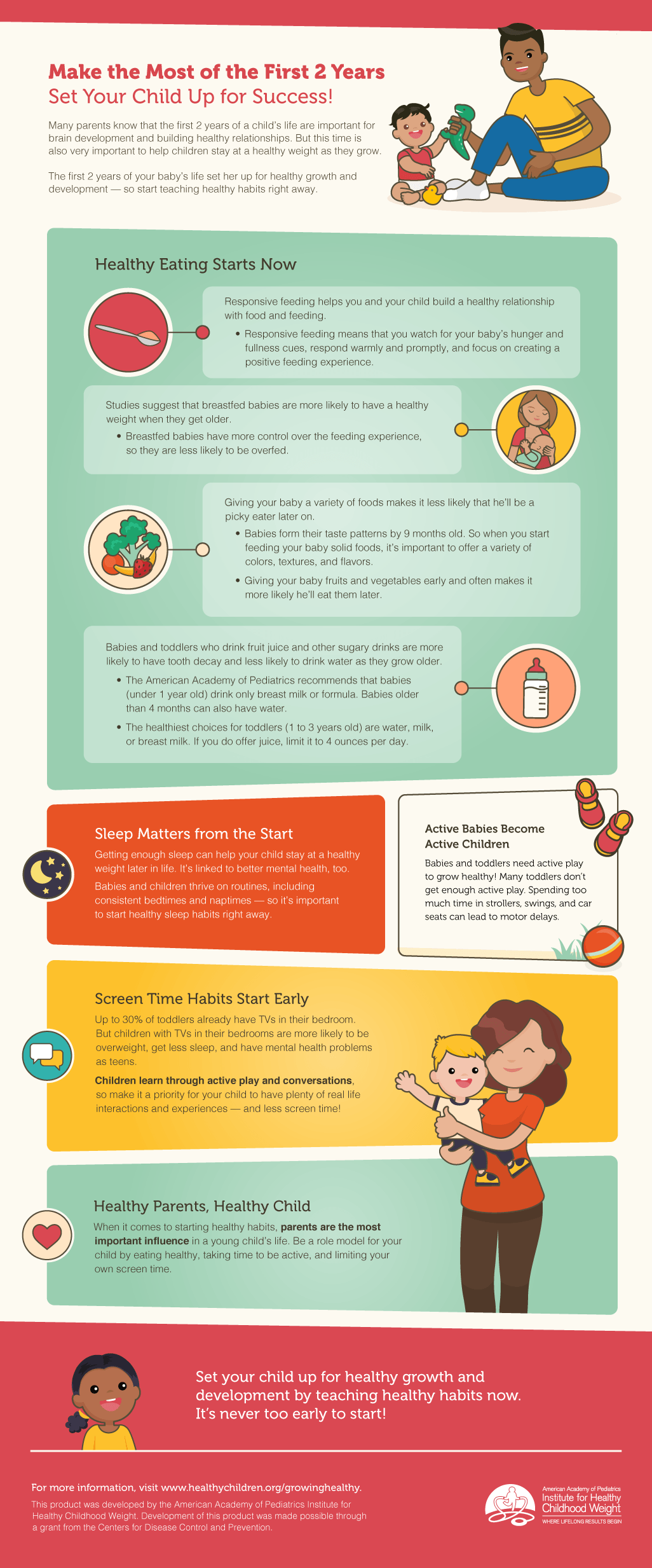
Healthy Habits to Master in Your Baby’s First Two Years
How Do Infants Learn?(Part2)

Take Care of Yourself
Children grow faster in their first year than at any other time in their lives. This will take a lot of your time and energy. You need to be healthy and happy to give your child the best start possible. When you feel good about yourself, you will be helping your baby feel happy and secure too. This is why you need to find the time to take care of yourself. Let people know when you need support or help. After you are rested, you will have more energy and you will be able to have more fun with your baby.
Others Who Care For Your Baby
Developing a close bond with parents and family members is important. It helps infants form positive relationships with others.
- By letting other people hold and talk with your baby when you are around, your baby learns how to relate to other people.
- When you cannot be with your baby, it is best if the same few trusted people are the caregivers. Your baby will learn to expect and enjoy their company and kindness.
- If you decide to leave your baby with a relative, friend, or professional child care provider, make sure that the caregiver and surroundings adequately provide a healthy, safe and comforting environment. This way, you will feel confident about the safe and loving care being provided.
A Strong Start for Life
Infants spend the first year learning to feel secure about being loved. Love—expressed in the ways mentioned here, and in many other ways by you—will give your child the physical strength to fight illness, the emotional strength to feel confident, and the ability to learn new things.
Last Updated 6/1/2012
Source Healthy Children Magazine, Back to School 2012
The information contained on this Web site should not be used as a substitute for the medical care and advice of your pediatrician. There may be variations in treatment that your pediatrician may recommend based on individual facts and circumstances.
How Do Infants Learn?(Part1)

Infants Are Amazing
In the very beginning, it may seem that your baby does nothing but eat, sleep, cry, and fill her diapers. But your infant is learning too. She can see and hear what is happening around her and can communicate her needs and interests to others. Parents can help their babies learn by playing with them.
Infants have the ability to see faces and objects of different shapes, sizes, and colors. They can tell the difference between the voices of their parents and others. We’re surprised when they mold their bodies into our arms or shoulders. We marvel at how they came into the world able to suck, communicate certain needs by crying, and, at times, calm down on their own. Most infants can do all of these things as soon as they are born.
You Are Your Baby‘s First Teacher
First experiences have a very important effect on the future. That’s why you are so important to your baby’s growth and development. The growth of your baby’s brain is affected by the care and experiences you provide. Loving attention helps new brain cells connect in ways that help infants:
- Feel secure and confident.
- Make sense of new ideas and information.
- Grow healthy bodies.
Things To Watch For
Your baby has a different style or personality from all other babies. It’s fun to get to know your baby’s likes, needs, and abilities. Find out how your baby relates to other people and situations.
- Some infants like more activity, some like less.
- Some infants are louder when they laugh or cry, some are quieter by nature.
All infants let us know when they have had enough. Some ways your baby may tell you that it‘s time for a nap are:
- Avoids making eye contact
- Becomes sleepy or fussy, may cry a lot
- Coughs or spits
- Rubs eyes
Last Updated 6/1/2012
Source Healthy Children Magazine, Back to School 2012
The information contained on this Web site should not be used as a substitute for the medical care and advice of your pediatrician. There may be variations in treatment that your pediatrician may recommend based on individual facts and circumstances.
Baby’s Temperament

Consider these two babies, both from the same family, both girls:
- The first infant is calm and quiet, happy to play by herself. She watches everything that happens around her, but rarely demands attention herself. Left on her own, she sleeps for long periods and eats infrequently.
- The second babyis fussy and startles easily. She thrashes her arms and legs, moving almost constantly whether awake or asleep. While most newborns sleep fourteen hours a day, she sleeps only ten, and wakens whenever there’s the slightest activity nearby. She seems in a hurry to do everything at once and even eats in a rush, gulping her feedings and swallowing so much air that she needs frequent burping.
Both these babies are absolutely normal and healthy. One is no “better” than the other, but because their personalities are so far apart, the two will be treated very differently, right from birth.
Like these babies, your infant will demonstrate many unique personality traits from the earliest weeks of life. Discovering these traits is one of the most exciting parts of having a new baby. Is she very active and intense, or relatively slow-going? Is she timid when faced with a new situation, such as the first bath, or does she enjoy it? You’ll find clues to her personality in everything she does, from falling asleep to crying. The more you pay attention to these signals and learn to respond appropriately to her unique personality, the calmer and more predictable your life will be in the months to come.
While most of these early character traits are built into the newborn’s hereditary makeup, their appearance may be delayed if your baby is born quite prematurely. Premature babies don’t express their needs—such as hunger, fatigue, or discomfort—as clearly as other newborns. They may be extra sensitive to light, sound, and touch for several months. Even playful conversation may be too intense for them and cause them to become fussy and look away. When this happens, it’s up to the parent to stop and wait until the baby is alert and ready for more attention. Eventually most of these early reactions will fade away, and the baby’s own natural character traits will become more evident.
Babies who are less than 5.5 pounds or 2.5 kg at birth (low birth weight), even if they’re full term, also may be less responsive than other newborns. At first they may be very sleepy and not seem very alert. After a few weeks they seem to wake up, eating eagerly but still remaining irritable and hypersensitive to stimulation between feedings. This irritability may last until they grow and mature further.
From the very beginning, your baby’s temperamental traits will influence the way you treat her and feel about her. If you had specific ideas about child rearing before she was born, reevaluate them now to see if they’re really in tune with her character. The same goes for expert advice—from books, articles, and especially from well-meaning relatives and friends—about the “right way” to raise a child. The truth is, there is no right way that works for every child. You have to create your own guidelines based on your child’s unique personality, your own beliefs, and the circumstances of your family life. The important thing is to remain responsive to your baby’s individuality. Don’t try to box her into some previously set mold or pattern. Your baby’s uniqueness is her strength, and respecting that strength from the start will help lay the best possible foundation for her high self-esteem and for loving relationships with others.
Last Updated 6/1/2009
Source Caring for Your Baby and Young Child: Birth to Age 5 (Copyright © 2009 American Academy of Pediatrics)
The information contained on this Web site should not be used as a substitute for the medical care and advice of your pediatrician. There may be variations in treatment that your pediatrician may recommend based on individual facts and circumstances.
Common Conditions in Newborns(Part3)
Jaundice
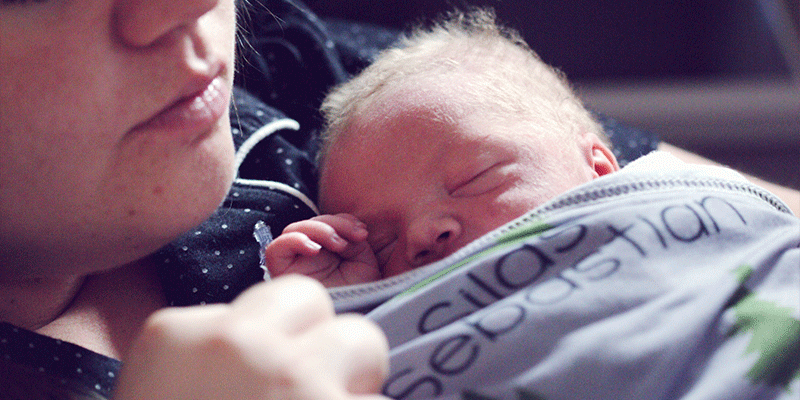
Many normal, healthy newborns have a yellowish tinge to their skin, which is known as jaundice. It is caused by a buildup of a chemical called bilirubin in the child’s blood. This occurs most often when the immature liver has not yet begun to efficiently do its job of removing bilirubin from the bloodstream (bilirubin is formed from the body’s normal breakdown of red blood cells). While babies often have a mild case of jaundice, which is harmless, it can become a serious condition when bilirubin reaches what the pediatrician considers to be a very high level. Although jaundice is quite treatable, if the bilirubin level is very high and is not treated effectively, it can even lead to nervous system or brain damage in some cases, which is why the condition must be checked for and appropriately treated. Jaundice tends to be more common in newborns who are breastfeeding, most often in those who are not nursing well; breastfeeding mothers should nurse at least eight to twelve times per day, which will help produce enough milk and help keep bilirubin levels low.
Jaundice appears first on the face, then on the chest and abdomen, and finally on the arms and legs in some instances. The whites of the eyes may also be yellow. The pediatrician will examine the baby for jaundice, and if she suspects that it may be present—based not only on the amount of yellow in the skin, but also on the baby’s age and other factors—she may order a skin or blood test to definitively diagnose the condition. If jaundice develops before the baby is twenty-four hours old, a bilirubin test is always needed to make an accurate diagnosis. At three to five days old, newborns should be checked by a doctor or nurse, since this is the time when the bilirubin level is highest; for that reason, if an infant is discharged before he is seventy-two hours old, he should be seen by the pediatrician within two days of that discharge. Some newborns need to be seen even sooner, including:
- Those with a high bilirubin level before leaving the hospital
- Those born early (more than two weeks before the due date)
- Those whose jaundice is present in the first twenty-four hours after birth
- Those who are not breastfeeding well
- Those with considerable bruising and bleeding under the scalp, associated with labor and
Lethargy and Sleepiness
Every newborn spends most of his time sleeping. As long as he wakes up every few hours, eats well, seems content, and is alert part of the day, it’s perfectly normal for him to sleep the rest of the time. But if he’s rarely alert, does not wake up on his own for feedings, or seems too tired or uninterested to eat, you should consult your pediatrician. This lethargy—especially if it’s a sudden change in his usual pattern—may be a symptom of a serious illness.
Last Updated 8/1/2009
Source Caring for Your Baby and Young Child: Birth to Age 5 (Copyright © 2009 American Academy of Pediatrics)
The information contained on this Web site should not be used as a substitute for the medical care and advice of your pediatrician. There may be variations in treatment that your pediatrician may recommend based on individual facts and circumstances.
Common Conditions in Newborns(Part2)
Excessive Crying
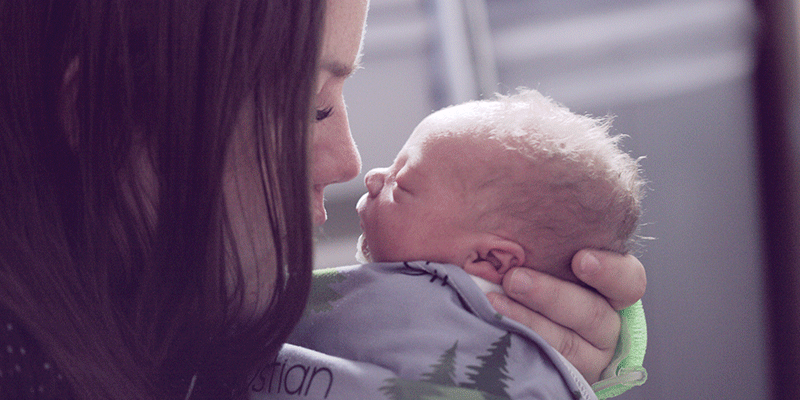
All newborns cry, often for no apparent reason. If you’ve made sure that your baby is fed, burped, warm, and dressed in a clean diaper, the best tactic is probably to hold him and talk or sing to him until he stops. You cannot “spoil” a baby this age by giving him too much attention. If this doesn’t work, wrap him snugly in a blanket.
You’ll become accustomed to your baby’s normal pattern of crying. If it ever sounds peculiar—for example, like shrieks of pain—or if it persists for an unusual length of time, it could mean a medical problem. Call the pediatrician and ask for advice.
Forceps Marks
When forceps are used to help during a delivery, they can leave red marks or even superficial scrapes on a newborn’s face and head where the metal pressed against the skin. These generally disappear within a few days. Sometimes a firm, flat lump develops in one of these areas because of minor damage to the tissue under the skin, but this, too, usually will go away within two months.
delivery
Those who have a parent or sibling who had high bilirubin levels and underwent treatment for it
When the doctor determines that jaundice is present and needs to be treated, the bilirubin level can be reduced by placing the infant under special lights when he is undressed—either in the hospital or at home. His eyes will be covered to protect them during the light therapy. This kind of treatment can prevent the harmful effects of jaundice. In infants who are breastfed, jaundice may last for more than two to three weeks; in those who are formula-fed, most cases of jaundice go away by two weeks of age.
Respiratory Distress
It may take your baby a few hours after birth to form a normal pattern of breathing, but then he should have no further difficulties. If he seems to be breathing in an unusual manner, it is most often from blockage of the nasal passages. The use of saline nasal drops, followed by the use of a bulb syringe, are what may be needed to fix the problem; both are available over the counter at all pharmacies.
However, if your newborn shows any of the following warning signs, notify your pediatrician immediately:
- Fast breathing (more than sixty breaths in one minute), although keep in mind that babies normally breathe more rapidly than adults.
- Retractions (sucking in the muscles between the ribs with each breath, so that her ribs stick out)
Flaring of her nose
- Grunting while breathing
- Persistent blue skin coloring
Last Updated 8/1/2009
Source Caring for Your Baby and Young Child: Birth to Age 5 (Copyright © 2009 American Academy of Pediatrics)
The information contained on this Web site should not be used as a substitute for the medical care and advice of your pediatrician. There may be variations in treatment that your pediatrician may recommend based on individual facts and circumstances.
Common Conditions in Newborns(Part1)

Some physical conditions are especially common during the first couple of weeks after birth. If you notice any of the following in your baby, contact your pediatrician.
Abdominal Distension
Most babies’ bellies normally stick out, especially after a large feeding. Between feedings, however, they should feel quite soft. If your child’s abdomen feels swollen and hard, and if he has not had a bowel movement for more than one or two days or is vomiting, call your pediatrician. Most likely the problem is due to gas or constipation, but it also could signal a more serious intestinal problem.
Birth Injuries
It is possible for babies to be injured during birth, especially if labor is particularly long or difficult, or when babies are very large. While newborns recover quickly from some of these injuries, others persist longer term. Quite often the injury is a broken collarbone, which will heal quickly if the arm on that side is kept relatively motionless. Incidentally, after a few weeks a small lump may form at the site of the fracture, but don’t be alarmed; this is a positive sign that new bone is forming to mend the injury.
Muscle weakness is another common birth injury, caused during labor by pressure or stretching of the nerves attached to the muscles. These muscles, usually weakened on one side of the face or one shoulder or arm, generally return to normal after several weeks. In the meantime, ask your pediatrician to show you how to nurse and hold the baby to promote healing.
Blue Baby
Babies may have mildly blue hands and feet, but this may not be a cause for concern. If their hands and feet turn a bit blue from cold, they should return to pink as soon as they are warm. Occasionally, the face, tongue, and lips may turn a little blue when the newborn is crying hard, but once he becomes calm, his color in these parts of the body should quickly return to normal. However, persistently blue skin coloring, especially with breathing difficulties and feeding difficulties, is a sign that the heart or lungs are not operating properly, and the baby is not getting enough oxygen in the blood. Immediate medical attention is essential.
Coughing
If the baby drinks very fast or tries to drink water for the first time, he may cough and sputter a bit; but this type of coughing should stop as soon as he adjusts to a familiar feeding routine. This may also be related to how strong or fast a breastfeeding mom’s milk comes down. If he coughs persistently or routinely gags during feedings, consult the pediatrician. These symptoms could indicate an underlying problem in the lungs or digestive tract.
Last Updated 8/1/2009
Source Caring for Your Baby and Young Child: Birth to Age 5 (Copyright © 2009 American Academy of Pediatrics)
The information contained on this Web site should not be used as a substitute for the medical care and advice of your pediatrician. There may be variations in treatment that your pediatrician may recommend based on individual facts and circumstances.


