How to Ease Your Child’s Separation Anxiety(Part2)
How to Survive Separation Anxiety
- Create quick good-bye rituals.Even if you have to do major-league- baseball–style hand movements, give triple kisses at the cubby, or provide a special blanket or toy as you leave, keep the good-bye short and sweet. If you linger, the transition time does too. So will the anxiety.
- Be consistent. Try to do the same drop-off with the same ritual at the same time each day you separate to avoid unexpected factors whenever you can. A routine can diminish the heartache and will allow your child to simultaneously build trust in her independence and in you.
- Attention: When separating, give your child full attention, be loving, and provide affection. Then say good-bye quickly despite her antics or cries for you to stay.
- Keep your promise. You’ll build trust and independence as your child becomes confident in her ability to be without you when you stick to your promise of return. The biggest mistake I ever made in this regard was returning to class to “visit”my son about an hour after a terrible transition. I was missing him, and although the return was well intended, I not only extended the separation anxiety, we started all over again in the process. When I left the second time (and subsequent days) it was near nuclear.
- Be specific, child style. When you discuss your return, provide specifics that your child understands. If you know you’ll be back by 3:00 pm, tell it to your child on his terms; for example, say, “I’ll be back after nap time and before afternoon snack.”Define time he can understand. Talk about your return from a business trip in terms of “sleeps.”Instead of saying, “I’ll be home in 3 days,” say, “I’ll be home after 3 sleeps.”
- Practice being apart. Ship the children off to grandma’s home, schedule playdates, allow friends and family to provide child care for you (even for an hour) on the weekend. Before starting child care or preschool, practice going to school and your good-bye ritual before you even have to part ways. Give your child a chance to prepare, experience, and thrive in your absence!
It’s rare that separation anxiety persists on a daily basis after the preschool years. If you’re concerned that your child isn’t adapting to being without you, chat with the pediatrician. Your pediatrician has certainly helped support families in the same situation and can help calm your unease and determine a plan to support both of you!
Additional Information:
- Top Tips for Surviving Tantrums
- Making Drop Off at Child Care Easier
- Working Mothers
- Preparing Your Child for Child Care
- Author Wendy Sue Swanson, MD, MBE, FAAP
Last Updated 11/21/2015
Source Mama Doc Medicine: Finding Calm and Confidence in Parenting, Child Health, and Work-Life Balance (Copyright © 2014 Wendy Sue Swanson)
The information contained on this Web site should not be used as a substitute for the medical care and advice of your pediatrician. There may be variations in treatment that your pediatrician may recommend based on individual facts and circumstances.
How to Ease Your Child’s Separation Anxiety(Part1)
Separation anxiety varies WIDELY between children. Some babies become hysterical when mom is out of sight for a very short time, while other children seem to demonstrate ongoing anxiety at separations during infancy, toddlerhood, and preschool.
To All You Working Moms & Dads
The trick for surviving separation anxiety demands preparation, brisk transitions, and the evolution of time. I would suggest we parents suffer as much as our children do when we leave. Even though we are often reminded that our children stop crying within minutes of our leave-taking, how many of you have felt like you’re “doing it all wrong” when your child clings to your legs, sobs for you to stay, and mourns the parting?
As a working mom, separation anxiety creates questions for me. Although it is an entirely normal behavior and a beautiful sign of a meaningful attachment, separation anxiety can be exquisitely unsettling for us all.
Here are facts about separation anxiety and tips to improve the transitions I‘ve learned the hard way (I‘ve made about every mistake):
Facts about Separation Anxiety
- Infants: Separation anxiety develops after a child gains an understanding of object permanence. Once your infant realizes you’re really gone (when you are), it may leave him unsettled. Although some babies display object permanence and separation anxiety as early as 4 to 5 months of age, most develop more robust separation anxiety at around 9 months. The leave- taking can be worse if your infant is hungry, tired, or not feeling well. Keep transitions short and routine if it’s a tough day.
- Toddlers: Many toddlers skip separation anxiety in infancy and start demonstrating challenges at 15 or 18 months of age. Separations are more difficult when children are hungry, tired, or sick—which is most of toddlerhood! As children develop independence during toddlerhood, they may become even more aware of separations. Their behaviors at separations will be loud, tearful, and difficult to stop.
- Preschoolers: By the time children are 3 years of age, most clearly understand the effect their anxiety or pleas at separation have on us. It doesn’t mean they aren’t stressed, but they certainly are vying for a change. Be consistent; don’t return to the room based on a child’s plea, and certainly don’t cancel plans based on separation anxiety. Your ongoing consistency, explanations, and diligence to return when you say you will are tantamount.
Last Updated 11/21/2015
Source Mama Doc Medicine: Finding Calm and Confidence in Parenting, Child Health, and Work-Life Balance (Copyright © 2014 Wendy Sue Swanson)
The information contained on this Web site should not be used as a substitute for the medical care and advice of your pediatrician. There may be variations in treatment that your pediatrician may recommend based on individual facts and circumstances.
Milestones During The First 2 Years
Long before your baby utters her first word, she has already started communicating with you, using smiles, looks, movements, and sounds. Children develop at different rates, but they usually are able to do certain things at certain ages. Following are general developmental milestones. Keep in mind that they are only guidelines.
If you have any questions about your baby’s development, ask your child’s pediatrician—the sooner the better. Even when there are delays, early intervention can make a significant difference.
By 1 year, most babies will
- Look for and be able to find where a sound is coming from.
- Respond to their name most of the time when you call it.
- Wave goodbye.
- Look where you point when you say, “Look at the _________.”
- Babble with intonation (voice rises and falls as if they are speaking in sentences).
- Take turns “talking”with you—listen and pay attention to you when you speak and then resume babbling when you stop.
- Say “da-da”to dad and “ma-ma”to mom.
- Say at least 1 word.
- Point to items they want that are out of reach or make sounds while pointing.
Between 1 and 2 years, most toddlers will
- Follow simple commands, first when the adult speaks and gestures, and then later with words alone.
- Get objects from another room when asked.
- Point to a few body parts when asked.
- Point to interesting objects or events to get you to look at them too.
- Bring things to you to show you.
- Point to objects so you will name them.
- Name a few common objects and pictures when asked.
- Enjoy pretending (for example, pretend cooking). They will use gestures and words with you or with a favorite stuffed animal or doll.
- Learn about 1 new word per week between 1½ and 2 years.
By 2 years of age, most toddlers will
- Point to many body parts and common objects.
- Point to some pictures in books.
- Follow 1-step commands without a gesture like “Put your cup on the table.”
- Be able to say about 50 to 100 words.
- Say several 2-word sentences and phrases like “Daddy go,””Doll mine,”and “All gone.”
- Be understood by others (or by adults) about half of the time.
Last Updated 8/14/2012
Source Autism Spectrum Disorders: What Every Parent Needs to Know (Copyright © American Academy of Pediatrics 2012)
The information contained on this Web site should not be used as a substitute for the medical care and advice of your pediatrician. There may be variations in treatment that your pediatrician may recommend based on individual facts and circumstances.
Stuttering in Toddlers & Preschoolers: What’s Typical, What’s Not?(Part3)
What Parents Can Do:
Here are some ways parents can help:
- Reduce communication stress. There are different techniques to put less pressure on a child in a speaking situation. Rephrasing questions as comments (using “You played outside today at school. It must have been fun!” instead of “What did you do at school?”) is one effective approach. Parents can also do their best to reduce situations that trigger their child’s stuttering.
- Talk about it. When children are aware of their stuttering, it is best to be open and talk about it in a positive way. Let them know it is okay to have “bumpy speech.” If a child does not seem to be aware of the problem, there is no need to bring it up until you are seeing a speech-language pathologist.
- Practice patience. Give children time to finish what they are saying. Don’t rush or interrupt them. Don’t tell them to “slow down” or “think about what you want to say.” Phrases such as those are generally not helpful to children who stutter.
- Model good speech habits. While telling a child how to talk is generally not helpful, parents can model speech habits that help with stuttering, such as slowing down their own speed when they talk, putting in more pauses between sentences, and speaking in a relaxed manner.
- Seek a professional. There are many ways to find a speech-language pathologist. A child’s pediatrician can provide a recommendation. Children younger than 3 can receive a free evaluation through their local Early Intervention Program. If a child is older than 3, parents can contact their local public school for a free evaluation. Parents also have the option to seek out a private speech-language pathologist with a child at any age. A searchable database of these professionals is available here. A list of stuttering specialists is available here.
Follow Your Instincts:
If you continue to have concerns about your child’s speech, ask for a reevaluation or referral for additional formal testing.
Additional Information & Resources:
- How to Raise Concerns about a Child’s Speech and Language Development
- Learn the Signs. Act Early (CDC.gov) – Aims to improve early identification of children with autism and other developmental disabilities so children and families can get the services and support they need.
- Stuttering (ASHA)
- Childhood Fluency Disorders (ASHA)
- National Stuttering Association
- Stuttering Foundation
Author Craig Coleman, CCC-SLP, BRS-FD
Last Updated 12/27/2016
Source Copyright © 2015 American Academy of Pediatrics and American Speech-Language-Hearing Association
The information contained on this Web site should not be used as a substitute for the medical care and advice of your pediatrician. There may be variations in treatment that your pediatrician may recommend based on individual facts and circumstances.
Stuttering in Toddlers & Preschoolers: What’s Typical, What’s Not?(Part2)

Risk Factors for Stuttering:
There are other risk factors that can help predict whether fluency problems will continue for longer than a few months.
- Family historyis the biggest predictor of whether a child is likely to stutter.
- Gender. Young boys are twice as likely as young girls to stutter, and elementary school-age boys are 3 to 4 times more likely to stutter than girls.
- Age of onset. Children that start having difficulties at age 4 are more likely to have a persistent stutter than those who begin stuttering at a younger age.
- Co-existingspeech and/or language disordersincrease the likelihood a child may stutter.
Getting Help:
If you are concerned about your child’s speech, talk with your pediatrician about getting a speech and language evaluation. A complete evaluation from a certified speech-language pathologist can help you to better determine if the stuttering is likely to persist.
Speech-language pathologists will help parents determine the best course of action (e.g., closely monitoring the child’s fluency, enrolling in treatment services, and/or parent education). The American Speech-Language-Hearing Association (ASHA) offers a searchable database of these professionals. In addition, a list of clinicians who specialize in stuttering can be found here.
Treatment Approaches for Stuttering:
Early treatment for stuttering is very important, as it is more likely to be eliminated when a child is young (before entering elementary school). There are two main treatment approaches for stuttering:
- Indirect treatment is when the speech-language pathologist helps the child’s parents on how to modify their own communication styles. Indirect approaches are effective at reducing or even eliminating stuttering in many young children.
- Direct treatment involves the speech-language pathologist working with the children themselves either one-on-one or in small groups, giving them specific speech strategies for easing into words and reducing tension during stuttering events. In addition, direct treatment may involve helping the child to differentiate between smooth (fluent) and bumpy (stuttered) speech.
After age 7, it becomes unlikely that stuttering will go away completely. Still, after age 7, treatment can be very effective at helping a child effectively manage stuttering—helping develop skills necessary to handle difficult situations (e.g., teasing and bullying) and participate fully in school and activities. For older children, speech treatment is still beneficial, encouraged, and effective in helping to reduce the severity and impact of stuttering.
Last Updated 12/27/2016
Source Copyright © 2015 American Academy of Pediatrics and American Speech-Language-Hearing Association
The information contained on this Web site should not be used as a substitute for the medical care and advice of your pediatrician. There may be variations in treatment that your pediatrician may recommend based on individual facts and circumstances.
Stuttering in Toddlers & Preschoolers: What’s Typical, What’s Not?(Part1)
As toddlers and preschoolers become increasingly verbal, they may begin to stumble over their words—raising concerns about stuttering. As a parent, how do you know when disfluencies are a normal part of development and when to be more concerned? Read on.
What are Typical Disfluencies?
It is not uncommon for young children to have disfluencies in their speech (e.g., word or phrase repetitions). In fact, about 5% of all children are likely to be disfluent at some point in their development, usually between ages 2 ½ and 5. It is also very typical for a child to go back and forth between periods of fluency and disfluency. Sometimes, this can occur for no apparent reason, but often this happens when a child is excited, tired, or feels rushed to speak.
Learning language rules:
During this time, children are expanding their vocabularies rapidly and learning complex language rules. These rules allow children to change simple messages (“Mommy juice”) into longer, more complicated sentences that require more motor coordination to produce smoothly (“Mommy put the juice in the blue cup”). It’s only natural that there may be some disruptions along the way.
Is It Truly Stuttering?
For most toddlers and preschoolers, most disfluencies go away on their own after a short period of time. In other cases, disfluencies persist and the signs of stuttering become more obvious. Getting professional help early offers the best chances for reducing stuttering. But how can parents tell the difference between typical disfluency that will go away and the early signs of non-typical disfluencies that may indicate stuttering?
Here are some ways to differentiate typical disfluency from stuttering:
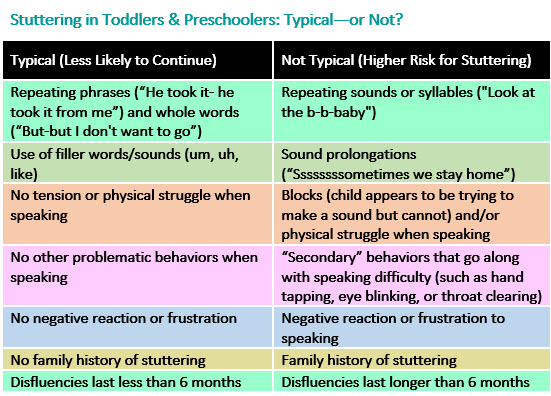
If your child is truly stuttering, he or she may hold out the first sound in a word, saying “Ssssssssometimes we stay home,” or repeat the sound, as in “Look at the b-b-b-baby!” In addition, children who stutter often develop other mannerisms such as eye blinking, tense mouth, looking to the side, and avoiding eye contact.
Last Updated 12/27/2016
Source Copyright © 2015 American Academy of Pediatrics and American Speech-Language-Hearing Association
The information contained on this Web site should not be used as a substitute for the medical care and advice of your pediatrician. There may be variations in treatment that your pediatrician may recommend based on individual facts and circumstances.
Tips for Grandparents of a 2-Year-Old

The third year of a child’s life, encompassing the so-called terrible twos, is often a challenging one for parents and therefore for grandparents, as well. A child at this age is showing increased physical activity, greater mood swings, frequent tantrums or demanding behavior, and testing the limits of all adults.
As a grandparent, you may have forgotten what two-year-olds are like; after all, it’s been many years since you raised your own children through this age.
Here are some guidelines to keep in mind when you spend time with your two-year-old grandchild (although some of these steps are more easily said than done):
- Make an effort to “keep your cool.” Don’t overreact to outbursts. Try to take them in stride, and realize that much of this behavior is designed to get you to react. Maintain a flexible but firm and loving response.
- Be consistent in your approach to discipline, and make sure it’s consistent with the disciplinary style of the child’s parents. Never use physical punishment.
- Reinforce good behaviors withpraiseand compliments. Become a role model of the way you would like your grandchild to act.
- Try to encourage self-control.
- Always be affectionate.
- Recognize that children of this age are very egocentric (i.e., they are thinking mostly of “me,” not of the others in their lives), so don’t take their lack of interest in you personally. This is normal for a two-year-old, and it won’t last forever.
- Toilet training will be one of your grandchild’s most important accomplishments at this age. Talk to his parents about the stage of training he’s in, and how you can reinforce what he has already achieved, particularly when you’re caring for him—babysitting on a Saturday afternoon or caring for him for the weekend. If he spends time in your home, purchase some extra training pants and have a potty chair identical to the one he is accustomed to at home.
- Safety in your homeremains important, so make sure your home is “childproofed.” Be especially careful of medications. Never leave them sitting out for his curious eyes or fingers; put them out of reach in a safe place that you will remember. Try to leave the medication there even after they leave, so that your home stays safe, even if they should stop by for a quick, unexpected visit. This is even more important if you cannot “unlock” the child-resistant caps and have chosen to put your pills in other types of containers. When medications are not in childproof containers, they can be easily opened by curious two-year-olds, so be especially vigilant with those.
Finally, always remember to place your grandchild in a car seat in the backseat for every trip in the automobile.
Additional Information:
Childproofing Tips for Grandparents
Tips for Grandparents Who Provide Child Care
How to Shape & Manage Your Young Child’s Behavior
Top Tips for Surviving Tantrums
Healthy Children Radio: Toddler Tantrums (Audio)
Last Updated 11/28/2018
Source Caring for Your Baby and Young Child: Birth to Age 5, 6th Edition (Copyright © 2015 American Academy of Pediatrics)
The information contained on this Web site should not be used as a substitute for the medical care and advice of your pediatrician. There may be variations in treatment that your pediatrician may recommend based on individual facts and circumstances.
Tips for Grandparents of a 1-Year-Old

You have an ongoing role to play in your grandchild’s nurturing and development. Though you must carefully “re-childproof” your house as a grandparent, there are many wonderful things your grandchildren can do with grandparents.
Here are some activities in which you can participate and some things to keep in mind as you do:
Motor Skills
Help your grandchild practice skills that tie in with your own likes and preferences. For example:
- Involve him in physical activities (e.g. sweeping, preparing food, or arranging items) around the house in which you can lend a helping hand to ensure his success and safety.
- Devise and initiate outdoor games and exercises that you and he can enjoy together.
Cognitive Milestones
To help your grandchild develop cognitively:
- Read special books to him.
- Play music and sing songs with him.
- Assist him as he begins to learn his numbers.
- Play hiding games like hide-and-seek and peekaboo.
- Mix fantasy play with real play.
Social Development
- Encourage your grandchild to interact with his peers, but keep in mind that egocentric behavior is normal for this age.
- Don’t overreact to selfishness or disregarding the feelings of others. Just reinforce that he should be sensitive to the feelings of other children.
- Do not give her a motorized riding toy.
- Do not give her a toy with any small parts or sharp edges. Stick with toys that are intended for toddlers, not for older children.
Water Safety
Never leave your toddler, even for a few seconds, in or near any body of water without supervision. This includes a bathtub, toilet, wading pool, swimming pool, fishpond, whirlpool, hot tub, lake, or ocean.
Auto Safety
- The safest place for all children to ride is in their car seat in the backseat.
- Never let your toddler climb out of his car seat while the car is moving.
- Keep in mind that this period of self-centeredness will taper off by the age of three.
- Nurture his self-esteem at every opportunity, but not at the expense of others.
Emotional Development
- Repeatedly tell your grandchild how special he is to you. Tell him how important your time together is to you.
- Don’t overreact to the mood swings he goes through—clinging one moment, independent the next, and defiant after that.
- Don’t reinforce his aggressiveness if it becomes abusive. Set limits, but do not physically restrain or punish him. Follow your own inclinations about the activities or areas that can promote hisdevelopment.
Additional Information:
Childproofing Tips for Grandparents
Car Seats: Information for Families
Tips for Grandparents Who Provide Child Care
How to Shape & Manage Your Young Child’s Behavior
Last Updated 12/5/2014
Source Caring for Your Baby and Young Child: Birth to Age 5, 6th Edition (Copyright © 2015 American Academy of Pediatrics)
The information contained on this Web site should not be used as a substitute for the medical care and advice of your pediatrician. There may be variations in treatment that your pediatrician may recommend based on individual facts and circumstances.
Using Their Words: Helping Preschoolers Get a Good Start in Reading and Learning(Part3)

The Lap of Literacy
As the ASHA puts it, “Toddlers are like little scientists.” They explore with all their senses, learn trial and error, cause and effect, and their brain growth increases through personal interaction with parents, grandparents, caregivers, and even other children. Reading aloud, laughing, talking, and exploring books together from an early age significantly improves language development and literacy outcomes for children in the long run.
Literacy begins in the lap of a loving parent or caregiver who takes the time to personally interact with their infant. “Some parents may have reading problems themselves, so that reading out loud to their children may be intimidating,” Dr. Fussell says. “In those cases — even if a parent just looks at a book and comments on the pictures with their child, asks the child questions about what’s going on in the pictures — that’s still ‘reading’!”
Teaching a Love for Books
The most important language stimulation we can provide to our infants and toddlers is reading to them, says Pamela High, M.D., FAAP. “I think that the most important thing parents do by reading with their infants, toddlers, and preschoolers is to teach them to love books and stories so much that they will be very motivated to learn to read, even when it is a difficult task for them,” she says.
That motivation is strengthened even as the bond between a parent and child grows while they share reading time. “The other really important aspect of reading with young children is that this always occurs within the relationship,” says Dr. High, who is Chair of the American Academy of Pediatrics Committee on Early Childhood, Adoption, and Dependent Care. “This activity provides busy parents a reason to slow down and pay total attention to their child and the story. This often becomes a favorite time of the day for both parent and child. When parents read with their children as part of a regular bedtime routine it also promotes healthy sleep habits.”
Reading, rhyming, singing, and talking — beginning from birth — profoundly influence literacy and language development, the foundations for all other learning. The results last a lifetime.
Quick Tips for Reading Fun
Start talking, singing, and reading with your child from the beginning. Even though your child can’t read when he’s an infant, he’ll get the idea that books are fun and reading is a fun activity you share together.
- Repetition is good — it helps a child build important language skills.
- Reading doesn’t have to be a huge project. Just a 3-minute story every night before bed will help get your child interested in reading.
- Board books and soft books are good for infants to get used to holding a book in their hands — and enjoying the experience.
This article was featured in Healthy Children Magazine. To view the full issue, click here.
Last Updated 11/2/2009
Source Healthy Children Magazine, Back to School 2008
The information contained on this Web site should not be used as a substitute for the medical care and advice of your pediatrician. There may be variations in treatment that your pediatrician may recommend based on individual facts and circumstances.
Using Their Words: Helping Preschoolers Get a Good Start in Reading and Learning(Part2)

The Building Blocks of Learning
Many people believe that children learn to read and write in kindergarten or first grade. However, the foundation for literacy skills is laid years before children enter school.
In light of a child’s need for early and frequent brain stimulation, there are several important steps parents and caregivers can take to help a child’s brain and language skills develop.
Engaging a child’s senses is very important right from birth. Singing, rhyming, and talking are very important. Babies develop listening skills and an interest in sounds and words from this activity.
Eventually the baby learns to understand certain patterns of sounds and tries to reproduce them, which marks the beginning of personal expression and two-way communication. Reading books aloud, showing pictures, and letting even infants handle written materials encourages to the child to learn visual recognition and to identify what she hears with what she sees.
“Parents don’t always think of giving books to infants,” says Jill Fussell, M.D., FAAP, assistant professor of pediatrics at the University of Arkansas for Medical Sciences. “But even young infants can visually attend to book pages with black-and-white patterns or with bright, contrasting colors for short time periods.”
No one expects an infant to read, but simply having a book in her hands can start the process of getting familiar with books and reading materials. “Although a 9- to 12-month-old may chew on a book or bang it on the floor, parents should still encourage children by including books in their repertoire of play objects,” says Dr. Fussell. “The same goes for reading to younger infants and toddlers. Parents need to be reminded of the power their voice has, and how their own babies will prefer to attend to their parent’s voice, given the opportunity, over other noises — such as a television.”
An important and normal part of developing early literacy skills for very young children is repetition. Sure, they may want to read the same storybook or look at the same pictures over and over. But this activity is actually “hard-wiring” their brains and providing consistent stimulation for language development, the cornerstone of literacy.
Using Their Words: Helping Preschoolers Get a Good Start in Reading and Learning(Part1)

It’s easy for a parent to become overwhelmed with emotions and expectations as a child grows up and gets ready for that first day of school. As the day nears for the beginning of preschool or kindergarten, the anxiety levels can climb, and the inevitable questions arise: Is she ready for this? Will he do well? We are all concerned that our children do well in the long run and succeed in school. In recent years, parents and professionals have become more aware that early childhood literacy is a key to a success in the classroom, and on into adulthood.
Children introduced to reading early on tend to read earlier and excel in school compared to children who are not exposed to language and books at a young age. The National Institute for Literacy estimates that one out of every five children in the U.S. will experience a reading or writing problem at some point during their school years.
Understanding Literacy
What is literacy? Simply put, it is our ability to read and write and learn. It’s been said that we spend the first few years of our lives learning to read, and the rest of our lives reading to learn. According to the American Speech-Language-Hearing Association (ASHA), good literacy skills include being able to read and understand age-appropriate information (comprehension), put letters together to form words (spelling), and write meaningful phrases and sentences.
As with many other aspects of a child’s growth, his literacy level is affected by genetics and environment. The genes a child inherits from her parents determine her brain’s basic “wiring,” while the home environment she grows up within helps determine how efficiently the “wires” are connected, and how well she adapts to the world around her.
Inside the Brain
In order to get a better grasp on this, we can look at the brain’s basic anatomy. The nervous system begins to operate very early in a developing fetus. Less than a month after conception, the neurological system’s basic structure is already established, and brain cells begin to form.
Each brain cell gradually sprouts hundreds of long branches called “dendrites” which connect to other brain cells via junctions called “synapses.” The electrical impulses our brain uses to send messages to the rest of the body are carried along these branches along a fatty sheath called “myelin” that covers the branches like bark on a tree. Chemicals called “neurotransmitters” help transfer the electrical pulses across our synapses to other branches. As an old saying goes, “Cells that fire together, wire together.” This “hard-wiring” of our brains continues throughout fetal development as the number of synapses continues to increase, peaking in the early years of our lives. The process declines by one-third between early childhood and adolescence.
Social Development in Preschoolers(Part4)
Bear in mind that even though your child is exploring the concepts of good and bad at this age, he still has an extremely simplified sense of morality. Thus, when he obeys rules rigidly, it’s not necessarily because he understands or agrees with them, but more likely because he wants to avoid punishment. In his mind, consequences count but not intentions. When he breaks something of value, for instance, he probably assumes he’s bad, whether he did it on purpose or not. But he needs to be taught the difference between accidents and misbehaving.
To help him learn this difference, you need to separate him—as a person— from his behavior. When he does or says something that calls for punishment, make sure he understands that he’s being punished for a particular act that he’s done, not because he’s “bad.” Instead of telling him that he is bad, describe specifically what he did wrong, clearly separating the person from the behavior. For example, if he is picking on a younger sibling, explain that it’s wrong to make someone else feel bad, rather than just saying “You’re bad.” When he accidentally does something wrong, comfort him and tell him you understand it was unintentional. Try not to get upset yourself, or he’ll think you’re angry at him rather than about what he did.
It’s also important to give your preschooler tasks that you know he can perform and then praise him when he does them well. He’s quite ready for simple responsibilities, such as helping to set the table or cleaning his room. When you go on family outings, explain that you expect him to behave well, and congratulate him when he does so. Along with the responsibilities, give him ample opportunities to play with other children, and tell him how proud you are when he shares or is helpful to another child.
Finally, it’s important to recognize that the relationship with older siblings can be particularly challenging, especially if the sibling is three to four years older. Often your four-year-old is eager to do everything his older sibling is doing; and just as often, your older child resents the intrusion. He may be resentful of the intrusion on his space, his friends, his more daring and busy pace, and especially his room and things. You often become the mediator of these squabbles. It’s important to seek middle ground. Allow your older child his own time, independence, and private activities and space; but also foster times of cooperative play when and where appropriate. Family vacations are great opportunities to enhance the positives of their relationship and at the same time give each their own activity and special time.
Last Updated 11/2/2009
Source Caring for Your Baby and Young Child: Birth to Age 5 (Copyright © 2009 American Academy of Pediatrics)
The information contained on this Web site should not be used as a substitute for the medical care and advice of your pediatrician. There may be variations in treatment that your pediatrician may recommend based on individual facts and circumstances.


