Expressing Breastmilk On The Job(Part1)

Readjusting to your previous work routine can be challenging enough without factoring in a breastfeeding schedule. Fortunately, you have taken the time to prepare your baby, your caregiver, your co-workers, and yourself for this new situation, so you are making the transition in the best possible way. Starting back to work in the middle of the work week will make it easier for everyone to adjust to the change, since this will provide you with a two- or three-day trial period before you take on a full workweek. Plan ahead to take certain items to work with you each day. Many women get everything together the night before. You will need your pump, a cooler for transporting and perhaps storing breast milk, and a lunch or snacks to help keep your energy up. You may also want to wear breast pads and pack a clean blouse or blazer in case of milk leakage or spills.
On the first day back at work, check in with your supervisor; remind him about your agreement regarding your breastfeeding schedule and make sure that the space allocated for expressing milk is still available. (If possible, visit during your maternity leave to check on the space and to finalize any arrangements. This will ease your mind on that busy first day back.) When you begin your first pumping sessions, try to relax and keep your mind off the people waiting for you outside the room. Any stress could delay your letdown reflex or reduce your milk supply, delaying your return even more. Trying to do paperwork or computer work at your desk or making phone calls while pumping is generally not effective. Thinking about your baby—how comforted she will be as she drinks your breast milk and how good for her your milk is—may help you relax and start your milk flow. Some women find that looking at a photograph of their baby or even listening to a tape of her hunger cry works like a charm.
Last Updated 11/2/2009
Source New Mother’s Guide to Breastfeeding, 2nd Edition (Copyright © 2011 American Academy of Pediatrics)
The information contained on this Web site should not be used as a substitute for the medical care and advice of your pediatrician. There may be variations in treatment that your pediatrician may recommend based on individual facts and circumstances.
Continuing Breastfeeding Beyond The First Year

If you are still breastfeeding your child through his first birthday, you can congratulate yourself on having provided him with the best nutrition he could possibly receive. Now that he is consuming a wide variety of solid foods, your breast milk has become somewhat less critical from a nutritional perspective. Some toddlers continue to consume a moderate amount of breast milk (and thus the nutrients it contains), while others “graze” and ingest smaller quantities, getting most of their nutrition elsewhere. Certainly there is no known point at which breast milk becomes nutritionally negligible. What we do know is that as your child moves from babyhood toward toddlerhood, breastfeeding continues to act as a source of profound comfort and security, laying the groundwork for a confident, happy, and healthy future. For this reason, as well as the continued nutritional and immunologic benefits of breastfeeding, the AAP advises mothers to continue nursing beyond the first year for as long as mutually desired by mother and child.
Starting the Journey Toward Self-Mangement
Many mothers appreciate the power and practicality of breastfeeding to soothe a toddler’s emotions, reassure him of their presence, and provide comfort in an often confusing world. Other women worry that continuing breastfeeding into toddlerhood prevents a child from learning to handle his emotions in alternative ways. The fact is, though, that toddlers need emotional reassurance frequently during the day. It is as valid and acceptable for a toddler to breastfeed for comfort as it is for him to suck a pacifier or thumb.
Dealing With Others’ Opinions
Our culture can sometimes project a somewhat limited view of acceptable breastfeeding practices; while nursing toddlers are becoming amore common sight, they still occasionally provoke comments and stares from uninformed adults. When deciding how long to breastfeed your child, a more valid yardstick than public opinion is your own child’s approach to nursing and your own feelings about it. These feelings are no doubt being communicated to your child. Do you feel that he is dependent on the breast for comfort to the point that it interferes with his social growth (just as a toddler whose relationship with his blanket is so intense that he’s unable to put it down to play with a friend)? Are you concerned that his continued nursing is causing other adults (such as a child care provider, preschool teacher, or other important person in his life) to label him in negative ways? Are your own mixed feelings about breastfeeding a toddler interfering with your relationship with him, making you a reluctant and less supportive partner? If your answers to all of these questions are no, then there is no reason to hasten the weaning process.
Mothers who have chosen to continue breastfeeding their toddlers have found many creative ways of dealing with the surprise and uninformed disapproval they encounter among other adults. Many women teach their children a “code word” to use when they want to breastfeed (such as “mimi” or “nonny”), so that the matter remains private between the two of them. Some women then retire with their toddlers to a private place to breastfeed. On the other hand, others make a point of breastfeeding in public, perhaps in the hopes of making it more acceptable for toddlers to continue nursing.
Certainly even in this country the general attitude toward breastfeeding is gradually improving. Thanks to political activism by parents’ groups and professional organizations, many states have enacted laws protecting a woman’s right to breastfeed. In fact, as of 2010, forty-four states, plus the District of Columbia and the Virgin Islands, had laws allowing mothers to nurse in any public or private location. Only five states have no breastfeeding laws of any kind. Most of these laws state that it is a woman’s right to breastfeed wherever she can legally be with her baby. Federal legislation guarantees the right of breastfeeding mothers to nurse their babies anywhere on federal property where the mother and baby have the right to be. This is a good thing not only for mothers, who so frequently have been harassed simply for caring for their children, but also for children, who benefit from all the nutrition, comfort, and love they receive. There is even federal legislation to protect the rights of working mothers to express their milk at the workplace.
We’re Doing Fine, Thanks: Deciding What’s Best For Your Child
In the end, the decision about how long to breastfeed your baby is one that only you—with help from your baby—should make. The nursing relationship is a unique bond, one that ideally should be supported by your partner and other family members. So whether it ends when your baby is six months old or three years old is a personal choice. Follow your instincts, and do what is best for you and your baby.
Last Updated 11/2/2009
Source New Mother’s Guide to Breastfeeding, 2nd Edition (Copyright © 2011 American Academy of Pediatrics)
The information contained on this Web site should not be used as a substitute for the medical care and advice of your pediatrician. There may be variations in treatment that your pediatrician may recommend based on individual facts and circumstances.
Ensuring Proper Latch On(Part2)

Many new mothers assume that infants are born knowing instinctively how to attach themselves to the breast and that if you present your breast in the proper way he will know what to do. Certainly some babies are capable of self-attachment, with good technique. This is most likely to occur in the first hour after birth but can be repeated later on. (Researchers have studied infants who are able to maneuver themselves from the mother’s lower abdomen, where they were placed immediately after delivery, up to the nipple, where they self-attach and start suckling. This has been called the “breast crawl.” Videos of this are available on the Internet.)
Most newborns do easily learn to latch on to the breast and soon begin the deep, regular suckling and rhythmic swallowing that typify successful nursing. But not all babies know instinctively how to latch on. You may need to teach your baby until he experiences enough successful feedings to associate his feeding behaviors with the satiation of his hunger.
The key to successful latching on involves taking enough of the breast into the mouth so that the nipple is drawn to the back of the baby’s mouth and his gums and tongue are compressing the areola, covering about an inch or two of the areola from the base of the nipple. This suckling movement causes your baby’s jaw to move the milk from the breast while his tongue makes a wavelike motion underneath the nipple, causing your milk to flow out through the tiny holes in your nipple. To achieve this, your baby’s mouth must truly be open wide as he latches on. Many early nursing mistakes occur when the mother hasn’t waited until her baby’s jaws are about as wide as they can be before she pulls him to her breast. As a result, the baby sucks on the nipple only, a position that limits the amount of milk received and soon makes the nipple sore.
To help your baby take in a large mouthful, use your C-hold to gently compress your breast; this makes the areola narrower and the nipple stick out more so it is easier to grasp. As he latches on, his tongue should stick out a bit, cover his lower gum, and partially envelop the breast. His lips should turn outward and press against your breast.
Try, Try Again
If your infant doesn’t manage to latch on properly the first time, gently detach him by sliding your finger into his mouth and pressing down on your breast to break the suction. You’ll know your baby didn’t latch on properly if you see indentations in his cheeks when he suckles, hear clicking noises, or notice his lips curled inward. He may also move his head frequently or not do any swallowing.
Incorrect latching may also cause pain for you. Don’t try to just pull him off your breast, since this could cause nipple pain. Keep practicing this latch-on technique until you and your newborn have mastered it, and don’t hesitate to ask the hospital nurses and lactation specialists for help.
Last Updated 11/21/2015
Source New Mother’s Guide to Breastfeeding, 2nd Edition (Copyright © 2011 American Academy of Pediatrics)
The information contained on this Web site should not be used as a substitute for the medical care and advice of your pediatrician. There may be variations in treatment that your pediatrician may recommend based on individual facts and circumstances.
Ensuring Proper Latch On(Part1)

In any of the nursing positions, when the baby is well aligned you should be able to draw a straight line that connects the baby’s ear, shoulder, and hip on either side of the baby’s body.
Once you and your baby are in proper position, the next step is to guide him toward the breast so that he can latch on properly and nurse. Latching on effectively is crucial to breastfeeding successfully because it prevents sore nipples, ensures sufficient milk supply, and stimulates plentiful milk production. In most cases (other than in the reclining position), it will be necessary to support your breast, at least in the early days of breastfeeding, in order for your baby to attach properly. This is especially true as milk production increases your breasts’ size and weight.
The C-Hold
Using your free hand, place four fingers under your breast and your thumb on top to present the nipple to your baby. (Your lactation specialist or nurse may refer to this as a C-hold, since your hand makes the shape of a letter C.) Make sure your fingers are well behind the areola (the darker-colored area around the nipple) so it doesn’t get in the way of your baby’s latching on to the breast. You can provide gentle compression of the breast with your fingers to make it easier for your baby to latch. Alternatively, you can place your fingers on your breast in a scissors or V-hold to guide the nipple, but only if your fingers are wide enough apart to expose the areola.
With the breast supported, stroke your baby’s lower lip with your nipple or bring his chin in to touch the breast closely. This causes him to open his mouth. (If his mouth stays closed, stroke his lip again, press gently down on his chin with your index finger, and open your own mouth, too, since he might imitate you.) When he opens wide—not just a little, but as though he’s giving a big yawn—quickly draw him closer and place his open mouth fully on your breast. This guiding movement should be quick but gentle. Remember that you should bring your baby to your breast, not push your breast into his mouth. If your baby’s head is pushed into the breast so hard that he cannot breathe, he may become agitated or frightened; he may arch his back and refuse to breastfeed.
Good Positioning
If your baby is in proper nursing position, his jaws will come together on your areola and his lips will seal over your breast. His chin and possibly his nose will touch your breast. (He will be able to breathe, but if you are concerned about his breathing, try lifting your breast or changing the angle of his body slightly, pulling his bottom in more closely to your body.) Helping him to latch on in a slightly asymmetric fashion, so that a bit more of the areola is in his mouth on the lower-lip side and a bit less on the upper-lip side, will position the nipple so it points toward the roof of the baby’s mouth.
You may feel slight discomfort when he first latches on and perhaps even for the first few sucks, but once he begins to suckle steadily you should not feel pain. Pain beyond the first minute or so of nursing is a sign of improper latching on and should be immediately corrected through further practice or with the help of a pediatrician, family physician, nurse, or lactation specialist. When pain persists throughout nursing, detach the baby by inserting your finger in thecorner of his mouth to break the suction and relatch him, making sure that his mouth is wide open before latching.
Last Updated 11/21/2015
Source New Mother’s Guide to Breastfeeding, 2nd Edition (Copyright © 2011 American Academy of Pediatrics)
The information contained on this Web site should not be used as a substitute for the medical care and advice of your pediatrician. There may be variations in treatment that your pediatrician may recommend based on individual facts and circumstances.
Establishing a Breastfeeding Routine
It is such a joy to observe an infant’s responses to the world. As you watch your newborn gaze in wonder at the people and objects around him, nestle against you with a whimper of pleasure, and occasionally startle in response to a loud noise, you may feel that you’re experiencing many of the wide range of emotions yourself. During the first days and weeks at home with a new baby, you may swing between feelings of joy and uncertainty, confidence and confusion, excitement and exasperation. These are all very natural and expected feelings. If your emotional responses during the postpartum period are more extreme than you expected or feel you can handle, you should notify your physician. In general, the simpler and more predictable you can keep your daily routine as you continue getting to know your baby and familiarizing yourself with breastfeeding, the better for you and your family.
Though one of the great advantages of breastfeeding is its adaptability—you can feed your baby practically anywhere without equipment and without delay—you might find that choosing one or two favorite places for breastfeeding at first will make your adjustment easier. During the day, you might opt for a sofa or chair in the living room or kitchen, since this allows you to take part in family life as you nurse. Some new mothers find that breastfeeding in bed, with plenty of pillows for support and their baby’s bassinet waiting close by, allows the baby to drift off comfortably to sleep at the end of the nursing session and makes it easier for the mother to nap.
Nursing mothers in many cultures sleep with their babies until they wean. The American Academy of Pediatrics, however, has expressed concern that bed sharing is hazardous. Bed sharing is a particular concern if the mother is obese; if she is using any substances that may alter her state of arousal, such as mind-altering drugs or excessive alcohol; if she is a smoker; or if other children are also in the bed. If you decide to let your infant sleep in your bed, never place him in a facedown position. Always place him on his back. Avoid soft surfaces, loose pillows, or loose covers, and move the bed away from the wall and other furniture to keep your baby from becoming trapped. Never put your baby to sleep on a waterbed. Consider moving him to his bassinet, on his back, after breastfeeding and before you drift off to sleep. It is also risky to fall asleep with your infant on a couch or in a reclining chair. The American Academy of Pediatrics recommends parents have their new babies sleep in the same room as the parents, but on a separate sleep surface, such as a bassinet.
Once you’ve picked a couple of locations for breastfeeding, make sure that such essentials as baby wipes and diapers are within reach before you start nursing. Keep a bottle of water or something else to drink nearby for you, as nursing mothers should drink plenty of water or other noncaffeinated beverages to avoid thirst.
If you have older children, a basket of toys, workbooks, or audio recordings can keep you from having to get up in the middle of a breastfeeding session. You might also keep a pad and pencil within reach to track your baby’s feedings. Finally, while studies have shown that eye contact and other communication during feedings benefit your infant’s brain development (and is rewarding for you too), you may want to keep a book, magazine, or the television remote control within reach for those times when he falls asleep in your arms. Of course, you won’t necessarily need every one of these items, nor do you need to create a formal “nursing area” to breastfeed successfully, but thinking ahead about what you might want nearby can make life more manageable in the early days.
Last Updated 11/2/2009
Source New Mother’s Guide to Breastfeeding, 2nd Edition (Copyright © 2011 American Academy of Pediatrics)
The information contained on this Web site should not be used as a substitute for the medical care and advice of your pediatrician. There may be variations in treatment that your pediatrician may recommend based on individual facts and circumstances.
Decreased Milk Supply

My six-month-old has completely lost interest in breastfeeding since I returned to my job. Is there anything I can do about this?
Some babies—particularly those older than six months—do gradually lose interest in breastfeeding as they adapt to the bottle. Frequently this loss of interest is tied to a lower milk supply.
To correct it, make a point of breastfeeding your baby frequently and always on demand—to comfort or soothe as well as nourish him. Breastfeed in a quiet, dimly lit place with few distractions, and consider increasing the number of night feedings. If he doesn’t complete a breastfeeding session, pump the remaining milk from your breasts to increase your milk supply.
Be aware, though, that some older babies simply wean themselves naturally at this point. If your baby has benefited from exclusive breastfeeding until now, congratulate yourself on providing him with the best possible nutrition for as long as he needed it.
Last Updated 11/2/2009
Source New Mother’s Guide to Breastfeeding, 2nd Edition (Copyright © 2011 American Academy of Pediatrics)
The information contained on this Web site should not be used as a substitute for the medical care and advice of your pediatrician. There may be variations in treatment that your pediatrician may recommend based on individual facts and circumstances.
Family Pressures to Bottle Feed

My mother-in-law did not nurse her children and feels very uncomfortable with my nursing. She‘s supportive in her way but wants to feed my two-week-old a bottle. Should I give in and let her do this?
It’s more important to establish and maintain your breastfeeding relationship with your infant right now than it is for your mother-in-law to feed her.
Try suggesting other ways to bond with her grandchild, such as cuddling her between nursing sessions, taking her for a stroll, bathing her, or changing her diaper.
Explain to her how important it is for you to breastfeed exclusively, point out the many advantages breastfeeding provides for your baby, and ask her to help you out by respecting your wishes in this area.
Last Updated 11/2/2009
Source New Mother’s Guide to Breastfeeding, 2nd Edition (Copyright © 2011 American Academy of Pediatrics)
The information contained on this Web site should not be used as a substitute for the medical care and advice of your pediatrician. There may be variations in treatment that your pediatrician may recommend based on individual facts and circumstances.
Common Myths About Breastfeeding
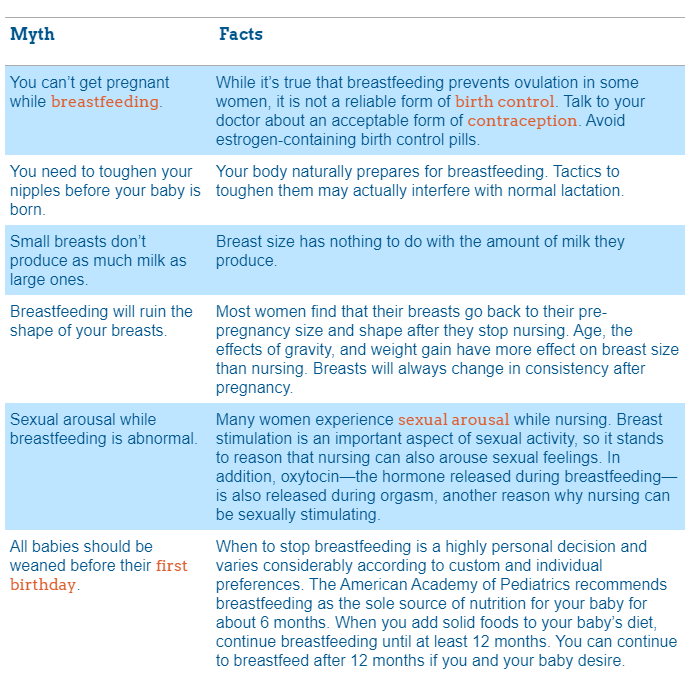
Last Updated 2/23/2012
Source Adapted from Nutrition: What Every Parent Needs to Know (Copyright © American Academy of Pediatrics 2011)
The information contained on this Web site should not be used as a substitute for the medical care and advice of your pediatrician. There may be variations in treatment that your pediatrician may recommend based on individual facts and circumstances.
Facts For Fathers About Breastfeeding

- Breastfeeding babies tend to be healthier than formula-fed babies—and you won’t have to deal with bottles, expensive cans of formula, or other equipment. You will save money that you would have spent to purchase formula.
- Breastfeeding has been shown to reduce the risk of breast, ovarian, and endometrial cancer in a mother’s later life and may reduce the risk of osteoporosis.
- Breastfeeding women use the weight (fat stores) they accumulated during pregnancy to produce breast milk.
- Women who breastfeed for more than twelve months during their lifetime tend to have lower risk of high blood pressure, high cholesterol, heart disease, and diabetes.
- A mother’s perception of her partner’s attitude toward breastfeeding is one of the greatest factors influencing her decision to breastfeed.
- Exclusive breastfeeding, with no supplemental formula or solid feedings, delays the mother’s ovulation and works as a natural form of birth control for the first six months after childbirth, if the mother has not resumed her menstrual cycles and if her baby is continuing to breastfeed fully both day and through the night.
- A breastfeeding mother whose partner supports her by taking care of household responsibilities is likely to be more successful and keep breastfeeding longer, enjoy family life more, and have more energy left over for her adult relationships.
- Babies’brain development depends on frequent verbal, physical, and emotional interaction with a familiar, loving caregiver. Babies need to be sung to, rocked, and played with as much as they need time breastfeeding. The baby needs these things and they will not spoil her.
- Eye contact between parent and infant is important for infant development. Mother and baby frequently make eye contact during breastfeeding. The non-breastfeeding partner can maintain eye contact while changing her diaper, giving her a bath, and playing with her.
- Growing children benefit from experiencing the different but complementary parenting styles of two different adults.
- The American Academy of Pediatrics recommends breastfeeding as the sole source of nutrition for your baby for about 6 months. When you add solid foods to your baby’s diet, a mother can continue breastfeeding until at least 12 months. A mother can continue to breastfeed after 12 months if she and your baby desire. Check with your child’s doctor about vitamin D and iron supplements during the first year.
Last Updated 2/23/2012
Source Adapted from New Mother’s Guide to Breastfeeding, 2nd Edition (Copyright © 2011 American Academy of Pediatrics)
The information contained on this Web site should not be used as a substitute for the medical care and advice of your pediatrician. There may be variations in treatment that your pediatrician may recommend based on individual facts and circumstances.
Clogged Milk Ducts

Sometime during the course of breastfeeding, you may experience a sore breast or notice a small lump on your breast that may be red or irritated and hurts when you touch it. This lump may be the result of a clogged milk duct, which can happen if there’s an abrupt change in the feeding schedule, inadequate draining of the breast, not varying nursing positions, or wearing clothes or bras that are too tight.
Treatment
A clogged duct should be dealt with immediately since it can lead to a breast infection. The best initial treatment for a clogged duct is to continue nursing, taking care to drain the breast as much as possible with each feeding. (If you suddenly stop breastfeeding, your breast will probably become engorged, which could make the condition worse and lead to an infection.)
Before each feeding, gently massage the breast, beginning on the outside and working your way toward the nipple, paying particular attention to the firm area. Breastfeed as often and as long as possible, offering your baby the sore breast first if you can tolerate it, because your baby will nurse most vigorously on the first breast, thus draining it more effectively.
Try switching positions to allow better drainage. Express milk from that breast after each feeding if your baby has not completely relieved breast fullness. Apply comfortably warm, moist towels on the affected breast several times a day (or take several warm baths or showers), gently massaging the area around the clogged duct down toward the nipple.
If the lump on your breast remains for more than a few days, if it increases in size or redness, or if you develop a fever or significant discomfort, make an appointment to see your doctor.
Prevention
Keeping pressure off your breasts will help prevent clogged ducts. You can do this by wearing clothing that is not restrictive (avoid tight tops, bras, or underwire bras; if necessary, switch to a larger bra size, or go without a bra for a while); by changing your nursing position so that your baby drains the milk from all areas of the breast equally; and by not sleeping on your stomach.
If you notice dried milk plugging the openings in your nipples, wash them gently with warm water after each breastfeeding session. Continued difficulties with clogged ducts may signal a problem with your baby’s latching on or with your nursing position. Arrange for a visit with your pediatrician or lactation specialist to correct these problems.
Last Updated 11/2/2009
Source New Mother’s Guide to Breastfeeding, 2nd Edition (Copyright © 2011 American Academy of Pediatrics)
The information contained on this Web site should not be used as a substitute for the medical care and advice of your pediatrician. There may be variations in treatment that your pediatrician may recommend based on individual facts and circumstances.
Colostrum: Your Baby’s First Meal

Colostrum provides all the nutrients and fluid that your newborn needs in the early days, as well as many substances to protect your baby against infections. Its color and thickness are due to the fact that it is higher in these protective factors. (Compared with more mature human milk, colostrum is also higher in protein, slightly lower in sugar, and significantly lower in fat.)
While your breasts will not feel full the day that you give birth, you already have enough colostrum to nourish your baby. Your body will produce colostrum for several days after delivery until your milk increases in amount and becomes more creamy or white in color—a time that mothers frequently refer to as the milk “coming in.”
First Feeding
Your baby will be born with a suckling instinct, though it is stronger in some babies than in others. Since this instinct is intense immediately after birth, it is best to introduce him to the breast within the first hour or so of life. Not only will his suckling at your breast stimulate your breasts to produce more milk, thus beginning the establishment of a reliable milk supply, but it will signal your uterus to contract and decrease the chance of excessive bleeding after delivery.
This first feeding will also help him begin to learn how to nurse. Placing the newborn baby skin to skin against your chest will help to encourage your baby to smell the colostrum and want to latch on and begin his first feeding. In fact, the initial phase of breastfeeding is a learning process for both mother and baby.
Some newborns show little initial interest in nursing. Fortunately, newborns do not need much fluid, and their mothers’ breasts contain only small amounts of the very important colostrum. At this stage, it is more important that babies feed frequently than it is for them to feed for long periods of time. Since the breasts are not yet extremely full of milk, they remain soft and supple after delivery, making it easier for the baby to learn to suckle.
In these early days, it is normal for a baby to lose some weight. This weight loss consists of extra fluid accumulated during pregnancy. In the days after delivery, your baby’s appetite and need for fluids will increase. Approximately two to five days after birth, the colostrum production will give way to a higher volume of transitional milk.
Last Updated 11/2/2009
Source New Mother’s Guide to Breastfeeding, 2nd Edition (Copyright © 2011 American Academy of Pediatrics)
The information contained on this Web site should not be used as a substitute for the medical care and advice of your pediatrician. There may be variations in treatment that your pediatrician may recommend based on individual facts and circumstances.
Engorgement

Your breasts may ache at times when they become uncomfortably full or engorged. Most mothers have experienced such fullness in their breasts at one time or another as their bodies readjust to a baby’s changing demands for breast milk. A little fullness during the first few days after birth is normal, but excessive engorgement, which can occur from missed feedings or a change in how often your baby nurses, can be quite painful.
Feeding frequently on demand helps prevent engorgement, but if your baby is nursing as often as she wants and is gaining weight, you may have to take extra measures to relieve the pressure on your breasts. You can, for example, soak a cloth in warm water and put it on your breasts or take a warm shower before feeding your baby. It may also help to express a small amount of milk before breastfeeding, either manually or with a breast pump. For severe engorgement, use a cool compress, gel pack, or ice pack between feedings to relieve discomfort and reduce swelling.
Discomfort due to engorgement may also be relieved by feeding your baby in more than one position. Try alternating sitting up, lying down, and using the football hold. Gently massage your breasts from under the arm and down toward the nipple to help reduce soreness and promote milk flow. If you have a forceful milk ejection that causes your baby to choke, try feeding her by lying down on your back with her lying on top of you. Take a break in the middle of a session to express a bit more if your baby starts to choke. While you do not want to take any medications without approval from your doctor, acetaminophen or ibuprofen may relieve pain and are safe to take occasionally during breastfeeding. Meanwhile, the best solution for engorgement is to keep breastfeeding. Soon your milk supply will better match your breastfeeding child’s demand, and you will feel much more comfortable.
As strange as it might sound, one treatment for engorgement that many breastfeeding women have found effective involves cabbage. Clean, refrigerated cabbage leaves can be either torn into smaller pieces or left whole and applied directly to the breast. Whole leaves will conform to the shape of the breast if the large central stem portion is removed first. Held in place by the bra, the cabbage is left against the breast as desired or until it becomes warm and wilts. The wilted leaves can be replaced by fresh, cool ones. Either green or red cabbage can be used, but red cabbage is more likely to stain a bra or clothing. Many mothers experience an improvement in the pain and swelling of engorgement within hours after using the cabbage. There is limited clinical research on the use of cabbage for engorgement, and the exact way in which cabbage decreases breast swelling is unknown, but the treatment appears to be harmless. For engorgement, cabbage should be used only until the swelling and pain begin to subside. Continued use may decrease the milk supply too much. Some mothers regularly apply cabbage to hasten the resolution of swelling or discomfort that occurs with weaning, especially when weaning occurs over a relatively brief time.
Last Updated 8/27/2019
Source New Mother’s Guide to Breastfeeding, 2nd Edition (Copyright © 2011 American Academy of Pediatrics)
The information contained on this Web site should not be used as a substitute for the medical care and advice of your pediatrician. There may be variations in treatment that your pediatrician may recommend based on individual facts and circumstances.


