Discomfort When Breastfeeding

I find that breastfeeding hurts a lot for the minute or so after my baby latches on. I know how important breastmilk is for her, but the initial pain makes me want to give up. Will this situation change?
Some new mothers feel more discomfort than others during different aspects of the breastfeeding process, and some women have more-sensitive nipples than others. Some feel, as you do, that the first few suckles of a breastfeeding session are uncomfortable.
It may help to know that most of these sensations fade after the first couple of weeks of breastfeeding. Other mothers dislike the feeling they experience as their milk lets down, but most mothers readily adjust to this brief “pins and needles” sensation.
It would be a shame to give up breastfeeding because of temporary feelings of discomfort. Hang in there for at least a week or two and then reassess how you feel.
If you have severe pain or discomfort that does not diminish as the baby settles into nursing, ask for help with latching on and request pain medication, if needed, that’s safe to take when breastfeeding.
Last Updated 11/2/2009
Source New Mother’s Guide to Breastfeeding, 2nd Edition (Copyright © 2011 American Academy of Pediatrics)
The information contained on this Web site should not be used as a substitute for the medical care and advice of your pediatrician. There may be variations in treatment that your pediatrician may recommend based on individual facts and circumstances.
Dad’s Role in Breastfeeding

Let’s say you and mom have talked about it and decided to go with breastfeeding. There are tons of things you can do to help, beginning even before the baby is born. While breastfeeding is instinctive, there can be a lot to learn to make sure it goes as well as possible. Many hospitals, obstetricians, pediatricians, and freestanding lactation centers offer breastfeeding classes, which they encourage expectant fathers to attend. The more you know about nursing, the more helpful you can be when the time comes.
Successful nursing depends on a host of factors, many of which you can help with.
- Positioning is key. Mom may need a pillow or help propping up to get baby lined up just right. At that moment she’s probably not in the best position to jump up and grab a pillow for support from across the room—you’re on it!
- Quench her thirst. In addition to all the other things prolactin does, it often causes mom to feel intensely thirsty just as her milk is really starting to flow. Does she have a glass of cold water? You know what to do.
- Be a hero. Nursing goes best when mom is relaxed and feeling happy about her baby. Can you adjust the lighting? Put on some music? Rub her back? These are all opportunities to be a hero.
Gastrocolic reflex
If you really want to earn your cape, you’ll remember the gastrocolic reflex. This is the medical term for the way the body makes room for incoming food by eliminating waste. In other words, it’s not your imagination that your baby poops every time she nurses. Step in to handle this issue regularly and you can guarantee mom will be bragging about you to anyone who will listen. Seriously, this is the stuff women talk about—just run with it.
Listening
Listening, of course, is an especially important way you can help. Nursing may be natural, but it can also be quite frustrating and uncomfortable, especially at first. Mom’s nipples may crack and bleed; her breasts can become uncomfortably engorged or even infected. You can help here, too, bringing her ointment or preparing warm compresses. But at times it’s even more important that you just listen and offer sympathy. Your support may literally make the difference in helping mom overcome the challenges of nursing.
Author David L. Hill, MD, FAAP
Last Updated 5/21/2012
Source Dad to Dad: Parenting Like a Pro (Copyright © American Academy of Pediatrics 2012)
The information contained on this Web site should not be used as a substitute for the medical care and advice of your pediatrician. There may be variations in treatment that your pediatrician may recommend based on individual facts and circumstances.
Nail Care: Fingers and Toes

Nail Care: Fingers and Toes
The only care your child’s nails require is trimming. You can use a soft emery board, baby nail clippers, or blunt-nosed toenail scissors, but be very careful when using clippers or scissors because accidentally cutting the tip of your baby’s finger will cause pain and bleeding.
A good time to trim nails is after a bath if your baby will lie quietly, but you may find it easiest to do when she’s asleep. Keep her fingernails as short and smoothly trimmed as possible so she can’t scratch herself (or you).
In the early weeks, her fingers are so small and her nails grow so quickly you may have to trim them twice a week. Also, as odd as it may sound, some parents bite their child’s nails as a way of trimming them, which they should avoid doing to prevent the risk of a condition called herpetic whitlow (a finger or thumb infection caused by the herpes simplex virus).
By contrast, your baby’s toenails grow much more slowly and are usually very soft and pliable. They needn’t be kept as short as the fingernails, so you may have to trim them only once or twice a month. Because they are so soft, they sometimes look as if they’re ingrown, but there’s no cause for concern unless the skin alongside the nail gets red, inflamed, or hard. As your baby gets older, his toenails will become harder and better defined.
Last Updated 11/2/2009
Source Caring for Your Baby and Young Child: Birth to Age 5 (Copyright © 2009 American Academy of Pediatrics)
The information contained on this Web site should not be used as a substitute for the medical care and advice of your pediatrician. There may be variations in treatment that your pediatrician may recommend based on individual facts and circumstances.
Baby Sunburn Prevention
 Why is a baby at special risk from sunburn?
A baby’s skin is more delicate and thinner than an adult’s and burns and irritates more easily. Even dark-skinned babies may be sunburned. Babies cannot tell you if they are too hot or beginning to burn and cannot get out of the sun without an adult’s help. Babies also need an adult to dress them properly and to apply sunscreen.
Prevention Tips
Learn how to stop sunburn before it happens and keep your baby happy, safe, and smiling:
- Babies younger than 6 months should be kept out of direct and indirect sunlight because of the risk of heat stroke. Particularly, avoid having a baby out between 10 a.m and 2 p.m. when the sun’s rays are strongest.
- Keep babies in the shade as much as possible. For example, they should be moved under a tree, beach umbrella, or stroller canopy. However, it is important to note that although on reflective surfaces, an umbrella or canopy may reduce UVR exposure by only 50%.
- Dress babies in lightweight cotton clothing with long sleeves and long pants and a sun hat with a wide brim.
- Sunscreen may be applied to babies younger than 6 months to small areas of skin uncovered by clothing and hats. Remember to cover all exposed areas of a baby’s skin, including the face, back of the hands, back of the neck, tips of the ears, and tops of the feet.
- Apply the protection 15 to 30 minutes before going out. Keep in mind that no sunscreens are truly waterproof, and thus they need to be reapplied every one and a half to two hours, particularly if a baby goes into the water. Consult the instructions on the bottle.
Last Updated 1/25/2013
Source Adapted from Pediatric Environmental Health, 3rd Edition (Copyright © American Academy of Pediatrics 2011)
The information contained on this Web site should not be used as a substitute for the medical care and advice of your pediatrician. There may be variations in treatment that your pediatrician may recommend based on individual facts and circumstances.
Infantile Hemangiomas: About Strawberry Baby Birthmarks(Part3)
What kinds of treatments are available for hemangiomas?
If a baby’s hemangioma risks causing problems, medications can be applied directly to the skin or taken by mouth. The goal is to keep them from getting any bigger during their period of rapid growth, or to make them shrink more quickly. Laser procedures or surgery may be an option in some cases, although it generally is avoided during early infancy to avoid increased anesthesia risks.
Systemic treatments
- Propranolol, a beta blocker medication used for many years to treat high blood pressure, is now commonly given by mouth as an effective treatment for problem hemangiomas. To avoid a growth rebound, the pediatrician may recommend therapy continue until your child’s first birthday. The drug must be used with close observation by your healthcare provider to watch for possible side effects and complications.
- Oral steroidshave been largely replaced by safer and more effective options, but are still used in select cases, determined by the healthcare provider.
Localized treatments
- Topical medications applied directly on the skin may be used for small, superficial hemangiomas. Prescription creams or ointments containing beta-blockers are the most effective topical treatment option to help stop growth and sometimes shrink and fade hemangiomas. In some cases, steroid creams may be prescribed for smaller, thinner hemangiomas.
- Steroid injections can be given directly into the hemangioma to help slow its growth.This works best for smaller, localized hemangiomas.
Other treatments
- Surgeryis usually only considered for smaller hemangiomas in areas where they may cause problems, or for small hemangiomas with broken skin. Because surgery will always leave a scar itself–and because most hemangiomas get better with time–early surgery is only recommended for a small minority of cases. Surgery can also repair extra skin or scars left by a hemangioma, but usually is delayed until a child is between 3 and 5 years old.
- Laser treatment may be helpful in some cases to stop bleeding or to help heal hemangiomas with open sores (ulcers). They can also help to remove some of the redness or texture changes that may be left behind after the hemangioma improves.
Remember:
Contact your pediatrician if you notice anything developing on your baby’s skin. Your baby’s first few well-child visits are also a great time to bring it up. Few hemangiomas cause any trouble, and most go away on their own. But prompt evaluation, monitoring and treatment, when needed, can help ensure problem hemangiomas have as little impact as possible on your child.
Last Updated 12/24/2018
Source American Academy of Pediatrics (Copyright © 2018)
The information contained on this Web site should not be used as a substitute for the medical care and advice of your pediatrician. There may be variations in treatment that your pediatrician may recommend based on individual facts and circumstances.
Infantile Hemangiomas: About Strawberry Baby Birthmarks(Part2)

What to do if you think your baby has an infantile hemangioma:
Infantile hemangiomas usually become noticeable by 4 weeks of age. They may start out looking like a tiny bump or scratch. But many then grow especially fast between 5 and 7 weeks old. If you think your baby might have a hemangioma, it’s best to contact your baby’s pediatrician right away. He or she probably will want to see your baby within a short timeframe. According to the AAP, the best “window of opportunity” to be evaluated and start treatment if needed is about 1 month of age.
Your pediatrician will want to know:
- Size: Is the hemangioma small (3/4″ or less across) or larger?
- Location:Is it located on the face or in the diaper area, or in a different area?
- Number:Is there one or more than one? If more than one, how many?
If your doctor can’t see you in the office right away, they may ask you to send photos or recommend a telemedicine visit to have a look without delay.
What to expect next:
It’s important to continue monitoring the hemangioma until it stops growing. Superficial hemangiomas typically reach their full size by 5 months of age, although deep hemangiomas sometimes keep growing a while longer. In some cases, your pediatrician may give a referral to an infantile hemangioma specialist with expertise in pediatric dermatology, hematology-oncology, otolaryngology, or plastic surgery.
By the time a baby is 6-18 months old, most hemangiomas begin to slowly improve. In a process called “involution,” the hemangioma will become less red and more grey or whitish and gradually flatten and shrink from the center outward.
Each case is different. Most hemangiomas have finished or almost finished flattening and shrinking by 4 to 5 years of age.
When does a hemangioma need to be treated?
Whether a hemangioma needs treatment depends on the age of the baby, where the hemangioma is located and how fast it is growing, whether it becomes sore or scabby, and the risk of it causing medical complications with a child’s health and well-being.
There are 3 main reasons for treatment:
- Medical problems. In rare cases and depending where they are located and how fast they are growing, hemangioma may begin to interfere with vital functions. Hemangiomas near the child’s eyes, nose or mouth, for example, can affect the child’s ability to see, eat, breath or hear well. In rare cases, hemangiomas grow inside the body, which may need to be monitored with imaging tests.
- Skin breakdown. Sometimes, skin on the hemangioma’s surface breaks down and becomes an open sore (called an ulcer) that could lead to bleeding, infection, or scarring.
- Permanent skin changes.Changes in the skin’s texture or color can remain even after the hemangioma has gone away. This can be a concern, especially for hemangiomas on the child’s face. Large hemangiomas on facial features such as the nose or lip can also distort growth.
Infantile Hemangiomas: About Strawberry Baby Birthmarks(Part1)
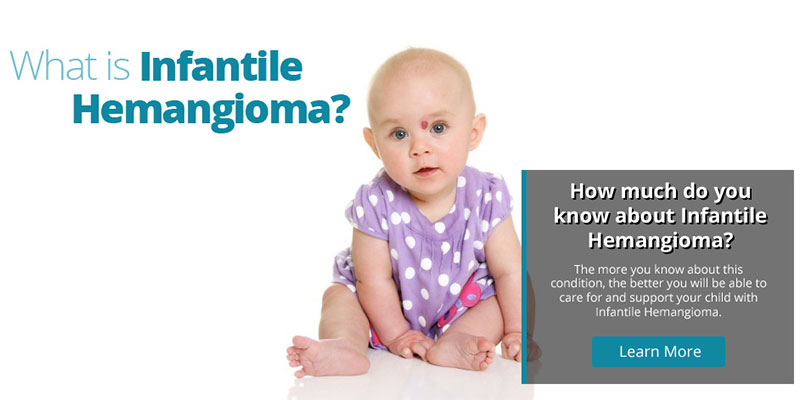
Hemangiomas are clusters of extra blood vessels on a baby’s skin. They may be there when a baby is born, or form within a few weeks or months of birth. Some may look like rubbery, bumpy red “strawberry” patches while others resemble deep bruises. Seeing a hemangioma develop can be worrisome for new parents.
The American Academy of Pediatrics (AAP) guidelines say it’s important to identify and begin monitoring infantile hemangiomas right after they appear―when they tend to change most quickly.
While hemangiomas can vary a lot in size, appearance, and placement, they are universally benign (non-cancerous). Most will go away on their own without causing any problems. Some hemangiomas―particularly those on the face or those that are very large―need treatment early to prevent them from interfering with body functions or causing permanent scars. Thankfully, there are excellent treatments available today to can prevent these problems if treated early on.
About Infantile Hemangiomas:
Infantile hemangiomas appear after a baby is born, typically within a month. Roughly 4% to 5% of all infants get them, although they are more common in Caucasians, girls, twins, and preterm or low-birth-weight babies. Infantile hemangiomas typically go through a period of rapid growth, followed by more gradual fading and flattening.
There are different types of infantile hemangiomas:
- Superficial hemangiomashave been called “strawberry marks,” because they can resemble the surface of berries. They may begin as small white, pink, or red areas on the skin that quickly change into brighter red, raised lesions. Superficial hemangiomas may be focused in one spot or spread out over a larger area.
- Deep hemangiomashave a smooth surface and form under the skin. They may have a bluish tint and resemble bruises. Some cause the skin to look swollen.
- Mixed hemangiomas are a combination of superficial and deep growths.
Are there other birthmarks like it?
Some of the other marks that can show up on a baby’s skin include port wine stains and “stork bites.” These also are caused when more blood than usual floods the capillaries under the skin. Port wine stains turn a reddish-purple and are often permanent; like hemangiomas, stork bites usually disappear, but can remain if they’re on the back of the neck.
Last Updated 12/24/2018
Source American Academy of Pediatrics (Copyright © 2018)
The information contained on this Web site should not be used as a substitute for the medical care and advice of your pediatrician. There may be variations in treatment that your pediatrician may recommend based on individual facts and circumstances.
Baby Birthmarks & Rashes(Part4)

By: Nick Nguyen, MD, FAAP & Sheilagh M. Maguiness, MD, FAAD, FAAP
Café-au-lait
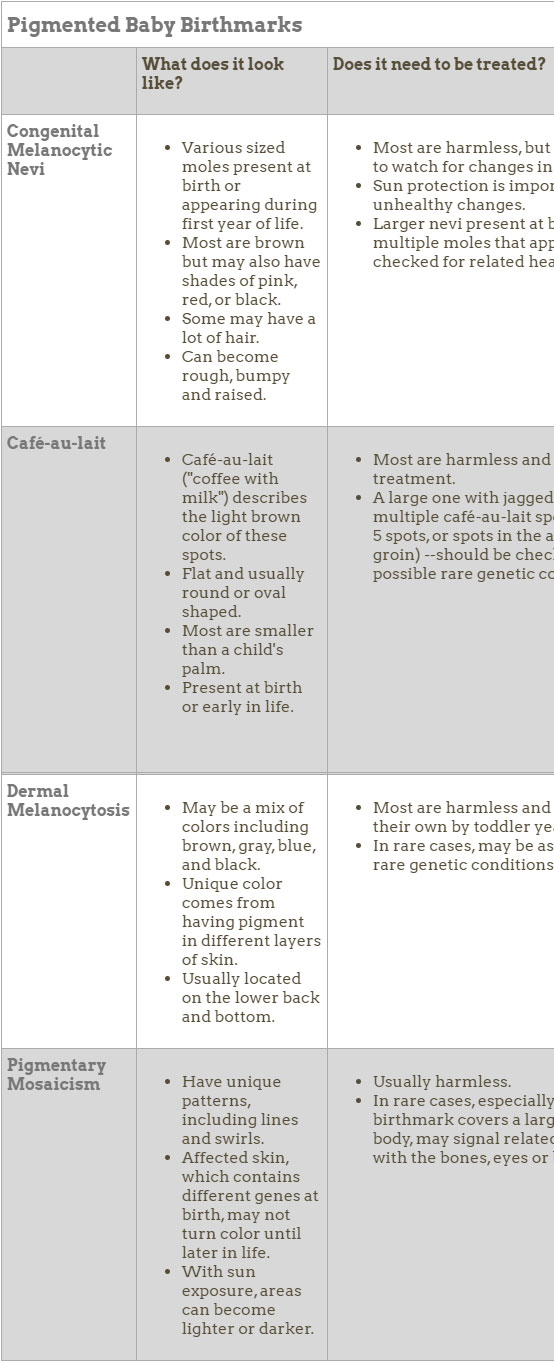
Café-au-lait means “coffee with milk,” which describes the light brown color of these common birthmarks. As many as 20-30% of people have one. The marks are flat and usually round or oval shaped. Most are smaller than a child’s palm and have smooth borders. They are visible at birth or develop very early in life.
Most café-au-lait spots are harmless. They are unlikely to turn into skin cancer, but may become darker with more sun exposure. A large café au lait spot with jagged borders may be linked with a rare genetic condition called McCune-Albright syndrome. Multiple café-au-lait spots can be a sign of other conditions, including one called neurofibromatosis. If your child has a large café-au-lait spot, more than 5 spots, or spots in the armpits/groin, talk with your pediatrician about them.
Dermal Melanocytosis
These are the most common birthmarks in babies with highly pigmented skin. They are seen in 85% of Asians, 96% of blacks & 46% of Hispanic babies at birth. They are usually located on the lower back and bottom, but some babies may have spots on different areas of the body. These birthmarks may be a mix of colors including brown, gray, blue and black. Their unique color comes from having pigment in different layers of the skin.
Most dermal melanocytosis birthmarks, which used to be called Mongolian spots, gradually fade. Many disappear by the toddler years. The majority of them are harmless and do not need treatment. In rare cases, these birthmarks may be associated with genetic conditions. If your baby has other health problems and several spots, please talk with your pediatrician.
Pigmentary Mosaicism
Mosaicism is a word that means two sets of DNA, or genes, are present in the same person. In pigmentary mosaicism, different genes might affect the color of the skin. These changes can be subtle or very large. Pigmentary mosaicism birthmarks have unique patterns including lines and swirls. With sun exposure, areas can become lighter or darker.
Even though the genetic change involved with pigmentary mosaicism is present at birth, the affected skin may not turn color until later in life. Sometimes sun exposure can cause this to happen. These changes can give the illusion that the birthmark is “spreading.” In most children, pigmentary mosaicism is harmless. A small number of may have problems with the bones, eyes or brain especially if their birthmark covers a large area of their body, so your pediatrician may recommend some tests.
Remember:
Most birthmarks are harmless and are part of what makes your child unique. But some types of birthmarks can come with potential health problems or may cause some children to feel self-conscious. That’s why it is important to talk with your pediatrician about any unusual marks or changes on your child’s skin. There are safe and effective treatment options available today that are especially effective when started early.
Last Updated 3/11/2019
Source American Academy of Pediatrics Section on Dermatology and Society for Pediatric Dermatology (Copyright © 2018)
The information contained on this Web site should not be used as a substitute for the medical care and advice of your pediatrician. There may be variations in treatment that your pediatrician may recommend based on individual facts and circumstances.
Baby Birthmarks & Rashes(Part3)

By: Nick Nguyen, MD, FAAP & Sheilagh M. Maguiness, MD, FAAD, FAAP
Venous Malformation
Venous malformations are tangles of veins in the skin that did not form properly during development. The veins give these birthmarks a blue or purple color. They are present at birth but may not become obvious until the teenage years. The veins can become larger with activity or certain positions, and they may become painful. Venous malformations are rare, affecting around 2 in 10,000 children.
These birthmarks may cause no problems at all. But treatment may be needed if the birthmark is painful or affects your child’s activities. Sometimes, small clots called phleboliths form in the veins. In most cases, these clots are not harmful but can be hard and cause pain. Compression garments, medications, surgery or procedures may be among treatment options.
Most venous malformations are located only in the skin, but sometimes they can also be found in muscles, bones, or organs. Your doctor may recommend a scan to get more information about your child’s birthmark.

Pigmented Baby Birthmarks—Brown & Grey
Brown and grey birthmarks may be made of extra melanocytes—the cells that produce pigment (color) in the skin. Pigmented birthmarks can look and behave differently from each other. Some are harmless, but others can come with health problems for your baby.
Congenital Melanocytic Nevi (Moles)
Congenital melanocytic nevi are commonly called moles. They can be present at birth or appear during the first year of life. These birthmarks are common, found in 1-3% of newborns. Congenital nevi can look very different from each other. Most are brown, but they may also have shades of pink, red, or black. Sometimes they have bumps or hair, and they may become rough or raised. Most congenital melanocytic nevi are harmless and usually do not require treatment or removal. Many dermatologists and pediatric dermatologist simply monitor them at well-child visits. They can also tell you what changes you should watch for in your child’s birthmark.
A nevi usually grows larger as your child grows, but not quickly. They are classified based on their size: small, medium and large/giant nevi. Large and giant nevi may have a higher risk for a type of skin cancer, melanoma, compared to small congenital nevi or other moles that appear later in life. It’s important for all children, but especially those with this type of birthmark, to wear sun protection outdoors.
A child with more than one congenital melanocytic nevus always needs to be evaluated by his or her pediatrician or pediatric dermatologist. Having more than one congenital nevus at birth may be related to problems with the brain and spinal cord. Your doctor may recommend a scan of these areas in this case, but this is extremely rare. Learn more and watch a video on identifying moles from The Society for Pediatric Dermatology.
Last Updated 3/11/2019
Source American Academy of Pediatrics Section on Dermatology and Society for Pediatric Dermatology (Copyright © 2018)
The information contained on this Web site should not be used as a substitute for the medical care and advice of your pediatrician. There may be variations in treatment that your pediatrician may recommend based on individual facts and circumstances.
Baby Birthmarks & Rashes(Part2)

By: Nick Nguyen, MD, FAAP & Sheilagh M. Maguiness, MD, FAAD, FAAP
Port Wine Stains
Port wine stains are fairly common, seen in about 3 in 1,000 children. They are similar to nevus simplex: flat, pink or red birthmarks made up of extra capillaries. They also are visible at birth. But these birthmarks are usually larger than nevus simplex and may affect more areas of the face and body. Unlike some other birthmarks, port wine stains do not go away. They grow as your child grows, but slowly. Over time, they may become darker and thicker.
Port wine stains aren’t usually linked to any health problems. If the birthmark affects a certain part of the face, like the eyelid and forehead, though, it may be related to a condition called Sturge-Weber syndrome. This condition is rare, but your doctor may recommend more evaluation or testing if your baby is at risk.
Some children and teens are not bothered by their port-wine stain, while others may feel self-conscious about them. Laser treatment may be able to lighten the birthmark some and help prevent darkening and thickening. But it will not “erase” the birthmark in most cases.
Infantile Hemangiomas
These benign growths, which usually appear in the first few weeks of life, are made of extra blood vessels in the skin. Infantile hemangiomas are fairly common–found in up to 5% of infants. They usually grow rapidly, and then gradually shrink and fade. If they form near the top of the skin, they are red (and sometimes called “strawberry marks”). Deeper in the skin, they may look blue or purple, like bruises.
Infantile hemangiomas grow most quickly in the first 5-7 weeks of life, so it is important to talk to your pediatrician about them early. Some hemangiomas may be associated with certain health problems and require additional testing and/or treatment. Safe treatments are available today for problem hemangiomas. But these treatments usually work best when started shortly after these birthmarks form–generally by around 1 month age. Talk with your pediatrician if you think your baby may have an infantile hemangioma.
Congenital Hemangiomas
Congenital hemangiomas are present at birth. Sometimes, they can be seen during prenatal ultrasound exams. They are different from infantile hemangiomas and much rarer. This type of hemangioma does not grow after the baby is born. Congenital hemangioma often look like a large round or oval bump or mass. They tend to be purple to blue, but may also have tiny red blood vessels on the surface and a white ring around the base.
Some of these birthmarks begin to disappear quickly (a type called rapidly involuting congenital hemangioma). Another type, non-involuting congenital hemangioma, does not go away at all. In most cases, congenital hemangiomas are not dangerous and do not need treatment. If the birthmark does not go away, it can be removed with surgery or other treatments when a child is older.
Last Updated 3/11/2019
Source American Academy of Pediatrics Section on Dermatology and Society for Pediatric Dermatology (Copyright © 2018)
The information contained on this Web site should not be used as a substitute for the medical care and advice of your pediatrician. There may be variations in treatment that your pediatrician may recommend based on individual facts and circumstances.
Baby Birthmarks & Rashes(Part1)

By: Nick Nguyen, MD, FAAP & Sheilagh M. Maguiness, MD, FAAD, FAAP
Gazing at your new baby, taking in every little detail, is one of the many joys of parenthood. Among many unique features you might notice is a birthmark, a different-looking spot on the skin that a baby is born with or develops soon after birth.
There are two main types of birthmarks: pigmented, spots of skin that contain extra pigment (color); and vascular, which contain extra blood vessels that didn’t fully form. Both types are usually harmless, and some go away on their own. But some need to be watched to make sure they don’t cause problems. Be sure to talk with your pediatrician about any birthmarks or rashes you notice on your baby.
Vascular Birthmarks—Pink, Red & Blue
Pink, red, and blue birthmarks often are made up of extra blood vessels. The extra blood can make some vascular birthmarks feel warm to touch. Vascular birthmarks may look and behave differently depending on the type of blood vessels in them. The most common blood vessel birthmarks include:
Nevus Simplex: “salmon patch,” “angel kiss” & “stork bite” birthmarks
Nevus simplex are flat pink or red birthmarks that up to 80% of babies are born with. They are collections of small, red blood vessels called capillaries. Often, these marks are located on the eyelids, forehead, back of neck, top of head, under the nose, and lower back. Sometimes, they are called “salmon patch” marks, “stork bites” (when located on back of the neck) and “angel kisses” (when they’re between the eyebrows).
Nevus simplex birthmarks usually will go away on their own by the time your baby is a toddler. Do not be alarmed if the birthmark gets darker when your baby becomes more emotional or active—this is normal.
Most nevus simples are totally harmless and do not need treatment. But be sure to talk with your pediatrician if they are large or located in unexpected areas.
Last Updated 3/11/2019
Source American Academy of Pediatrics Section on Dermatology and Society for Pediatric Dermatology (Copyright © 2018)
The information contained on this Web site should not be used as a substitute for the medical care and advice of your pediatrician. There may be variations in treatment that your pediatrician may recommend based on individual facts and circumstances.
A Breastfeeding Checklist: Are You Nursing Correctly?

Signs of Correct Nursing
- Your baby’s mouth is open wide with lips turned out.
- His chin and nose are resting against the breast.
- He has taken as much of the areola as possible into his mouth.
- He is suckling rhythmically and deeply, in short bursts separated by pauses.
- You can hear him swallowing regularly.
- Your nipple is comfortable after the first few suckles.
Signs of Incorrect Nursing
- Your baby’s head is not in line with his body.
- He is sucking on the nipple only, instead of suckling on the
areola with the nipple far back in his mouth.
- He is sucking in a light, quick, fluttery manner rather than taking deep, regular sucks.
- His cheeks are puckered inward or you hear clicking noises.
- You don’t hear him swallow regularly after your milk production has increased.
- You experience pain throughout the feed or have signs of nipple damage (such as cracking or bleeding).
Last Updated 11/2/2009
Source New Mother’s Guide to Breastfeeding, 2nd Edition (Copyright © 2011 American Academy of Pediatrics)
The information contained on this Web site should not be used as a substitute for the medical care and advice of your pediatrician. There may be variations in treatment that your pediatrician may recommend based on individual facts and circumstances.


